Solve each problem. See Examples 1–4. Diameter of the Sun To determine the diameter of the sun, an astronomer might sight with a transit (a device used by surveyors for measuring angles) first to one edge of the sun and then to the other, estimating that the included angle equals 32'. Assuming that the distance d from Earth to the sun is 92,919,800 mi, approximate the diameter of the sun.
Table of contents
- 0. Review of College Algebra4h 45m
- 1. Measuring Angles40m
- 2. Trigonometric Functions on Right Triangles2h 5m
- 3. Unit Circle1h 19m
- 4. Graphing Trigonometric Functions1h 19m
- 5. Inverse Trigonometric Functions and Basic Trigonometric Equations1h 41m
- 6. Trigonometric Identities and More Equations2h 34m
- 7. Non-Right Triangles1h 38m
- 8. Vectors2h 25m
- 9. Polar Equations2h 5m
- 10. Parametric Equations1h 6m
- 11. Graphing Complex Numbers1h 7m
2. Trigonometric Functions on Right Triangles
Solving Right Triangles
Problem 55
Textbook Question
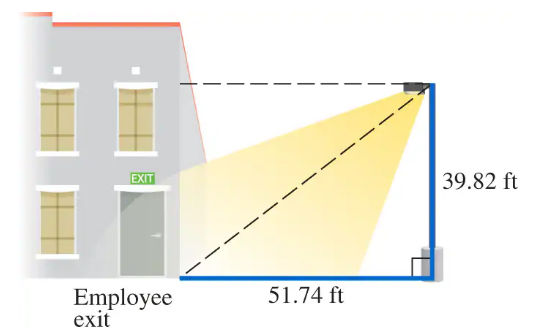
Solve each problem. See Examples 3 and 4. Angle of Depression of a Light A company safety committee has recommended that a floodlight be mounted in a parking lot so as to illuminate the employee exit, as shown in the figure. Find the angle of depression of the light to the nearest minute.

Verified step by step guidance1
Identify the right triangle formed by the floodlight, the point on the ground where the light is aimed (employee exit), and the vertical height of the floodlight from the ground.
Label the height of the floodlight as the opposite side and the horizontal distance from the base of the floodlight to the employee exit as the adjacent side of the right triangle.
Recall that the angle of depression from the floodlight to the employee exit corresponds to the angle between the horizontal line from the floodlight and the line of sight to the exit, which is congruent to the angle inside the triangle adjacent to the horizontal side.
Use the tangent trigonometric ratio, which relates the opposite side and adjacent side: \(\tan(\theta) = \frac{\text{opposite}}{\text{adjacent}}\) where \(\theta\) is the angle of depression.
Calculate \(\theta\) by taking the inverse tangent (arctangent) of the ratio: \(\theta = \tan^{-1}\left(\frac{\text{opposite}}{\text{adjacent}}\right)\), then convert the decimal degrees to degrees and minutes to express the angle to the nearest minute.
Verified video answer for a similar problem:This video solution was recommended by our tutors as helpful for the problem above
Video duration:
4mPlay a video:
0 Comments
Key Concepts
Here are the essential concepts you must grasp in order to answer the question correctly.
Angle of Depression
The angle of depression is the angle formed between the horizontal line from the observer's eye and the line of sight looking downward to an object. It is measured downward from the horizontal and is congruent to the angle of elevation from the object to the observer.
Recommended video:
Coterminal Angles
Right Triangle Trigonometry
Right triangle trigonometry involves using sine, cosine, and tangent ratios to relate the angles and sides of a right triangle. These ratios help find unknown lengths or angles when some measurements are given, which is essential in solving problems involving angles of elevation or depression.
Recommended video:
45-45-90 Triangles
Converting Decimal Degrees to Degrees and Minutes
Angles are often expressed in degrees, minutes, and seconds, where one degree equals 60 minutes. Converting decimal degrees to degrees and minutes involves separating the integer part as degrees and multiplying the decimal part by 60 to find the minutes, providing a more precise angle measurement.
Recommended video:
Converting between Degrees & Radians
Related Videos
Related Practice
Textbook Question
557
views