Solve each right triangle. In each case, C = 90°. If angle information is given in degrees and minutes, give answers in the same way. If angle information is given in decimal degrees, do likewise in answers. When two sides are given, give angles in degrees and minutes. See Examples 1 and 2. A = 53°24', c = 387.1 ft
Table of contents
- 0. Review of College Algebra4h 45m
- 1. Measuring Angles40m
- 2. Trigonometric Functions on Right Triangles2h 5m
- 3. Unit Circle1h 19m
- 4. Graphing Trigonometric Functions1h 19m
- 5. Inverse Trigonometric Functions and Basic Trigonometric Equations1h 41m
- 6. Trigonometric Identities and More Equations2h 34m
- 7. Non-Right Triangles1h 38m
- 8. Vectors2h 25m
- 9. Polar Equations2h 5m
- 10. Parametric Equations1h 6m
- 11. Graphing Complex Numbers1h 7m
2. Trigonometric Functions on Right Triangles
Solving Right Triangles
Problem 50
Textbook Question
Solve each problem. See Examples 1–4. Altitude of a Triangle Find the altitude of an isosceles triangle having base 184.2 cm if the angle opposite the base is 68°44'.
Verified step by step guidance1
Identify the given elements: the base of the isosceles triangle is 184.2 cm, and the angle opposite the base is 68°44'. Since the triangle is isosceles, the two equal sides meet at this angle.
Convert the angle 68°44' into decimal degrees for easier calculation: 68° + (44/60)°.
Draw the altitude from the vertex opposite the base to the base, which will bisect the base into two equal segments of length \(\frac{184.2}{2}\) cm each.
Use the right triangle formed by the altitude, half the base, and one of the equal sides. Apply the trigonometric function sine to relate the altitude (opposite side) to the hypotenuse (equal side). The altitude \(h\) can be found using \(h = \left( \frac{184.2}{2} \right) \times \tan\left( \frac{68.7333}{2} \right)\), where \$68.7333$ is the decimal form of the angle.
Calculate the altitude \(h\) by evaluating the tangent of half the angle and multiplying by half the base length.
Verified video answer for a similar problem:This video solution was recommended by our tutors as helpful for the problem above
Video duration:
6mPlay a video:
0 Comments
Key Concepts
Here are the essential concepts you must grasp in order to answer the question correctly.
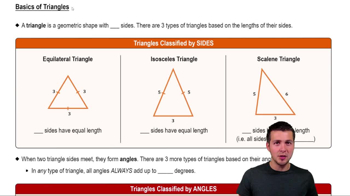
Properties of Isosceles Triangles
An isosceles triangle has two equal sides and two equal angles opposite those sides. The altitude from the vertex angle bisects the base and creates two congruent right triangles, which helps in calculating unknown lengths using trigonometric ratios.
Recommended video:
Review of Triangles
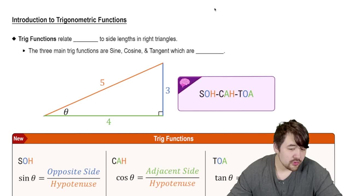
Trigonometric Ratios in Right Triangles
Trigonometric ratios such as sine, cosine, and tangent relate the angles of a right triangle to the ratios of its sides. These ratios allow calculation of unknown side lengths or angles when one side and one angle are known.
Recommended video:
Introduction to Trigonometric Functions
Angle Conversion and Use of Degrees and Minutes
Angles given in degrees and minutes (e.g., 68°44') must be converted to decimal degrees or used directly in trigonometric calculations. Understanding this notation is essential for accurate computation of trigonometric functions.
Recommended video:
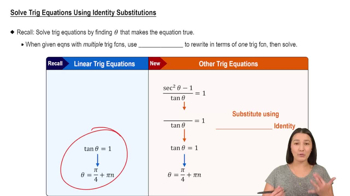
Solve Trig Equations Using Identity Substitutions
Related Videos
Related Practice
Textbook Question
516
views