Determine whether each pair of vectors is orthogonal. 〈1, 1〉, 〈1, -1〉
Verified step by step guidance
1
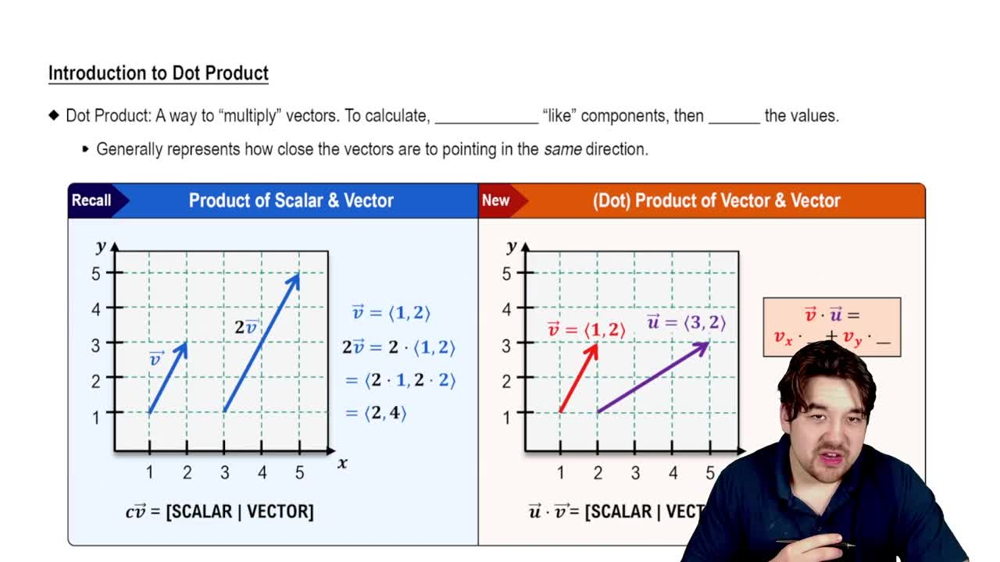
Recall that two vectors are orthogonal if their dot product is zero. The dot product of two vectors \(\langle a_1, a_2 \rangle\) and \(\langle b_1, b_2 \rangle\) is given by the formula:
\[
\text{Dot product} = a_1 \times b_1 + a_2 \times b_2
\]
Identify the components of the given vectors: the first vector is \(\langle 1, 1 \rangle\) and the second vector is \(\langle 1, -1 \rangle\).
Calculate the dot product using the components:
\[
(1) \times (1) + (1) \times (-1)
\]
Simplify the expression to find the value of the dot product.
Check if the dot product equals zero. If it does, the vectors are orthogonal; if not, they are not orthogonal.
Verified video answer for a similar problem:
This video solution was recommended by our tutors as helpful for the problem above
Play a video:
0 Comments
Key Concepts
Here are the essential concepts you must grasp in order to answer the question correctly.
Vector Representation
Vectors are quantities defined by both magnitude and direction, often represented as ordered pairs or tuples in coordinate form. In two dimensions, a vector like 〈x, y〉 indicates movement x units along the horizontal axis and y units along the vertical axis.
The dot product is an algebraic operation that takes two equal-length sequences of numbers (vectors) and returns a single number. For vectors 〈a, b〉 and 〈c, d〉, the dot product is calculated as a*c + b*d, which relates to the angle between the vectors.
Two vectors are orthogonal if their dot product equals zero, meaning they are perpendicular to each other. This concept is fundamental in trigonometry and vector analysis to determine right angles between vectors.

 Verified step by step guidance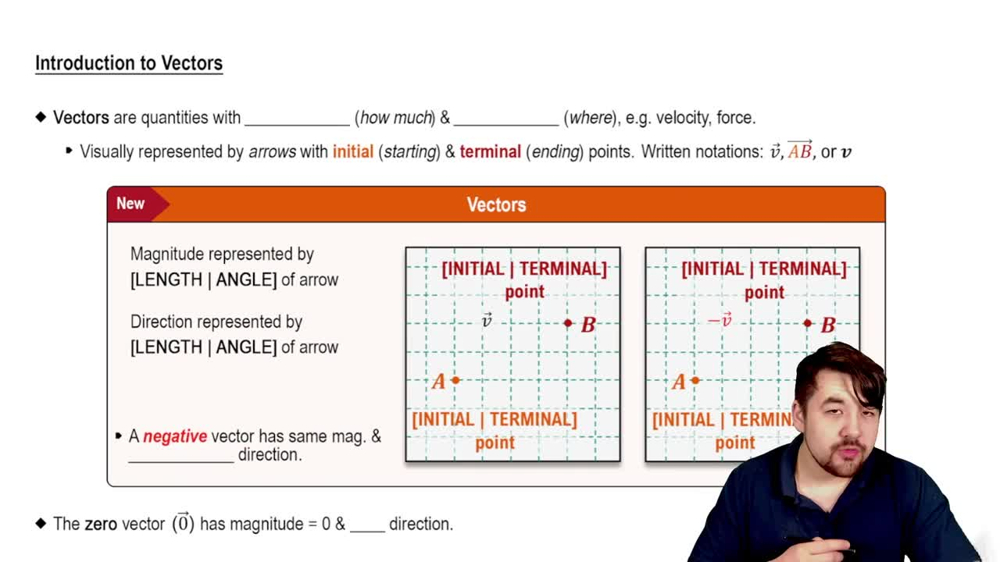
 03:48
03:48