Use identities to fill in each blank with the appropriate trigonometric function name. ____ 72° = cot 18°
Verified step by step guidance
1
Recall the complementary angle identity for cotangent: \(\cot(\theta) = \tan(90^\circ - \theta)\).
Apply this identity to the given expression \(\cot 18^\circ\): rewrite it as \(\tan(90^\circ - 18^\circ)\).
Calculate the complementary angle: \(90^\circ - 18^\circ = 72^\circ\).
Therefore, \(\cot 18^\circ = \tan 72^\circ\).
Fill in the blank with the function name 'tan' to complete the identity: \(\tan 72^\circ = \cot 18^\circ\).
Verified video answer for a similar problem:
This video solution was recommended by our tutors as helpful for the problem above
Play a video:
0 Comments
Key Concepts
Here are the essential concepts you must grasp in order to answer the question correctly.
Complementary Angle Identities
Complementary angle identities relate trigonometric functions of angles that add up to 90°. For example, sin(90° - θ) = cos θ and tan(90° - θ) = cot θ. These identities help transform one trigonometric function into another by using the complementary angle.
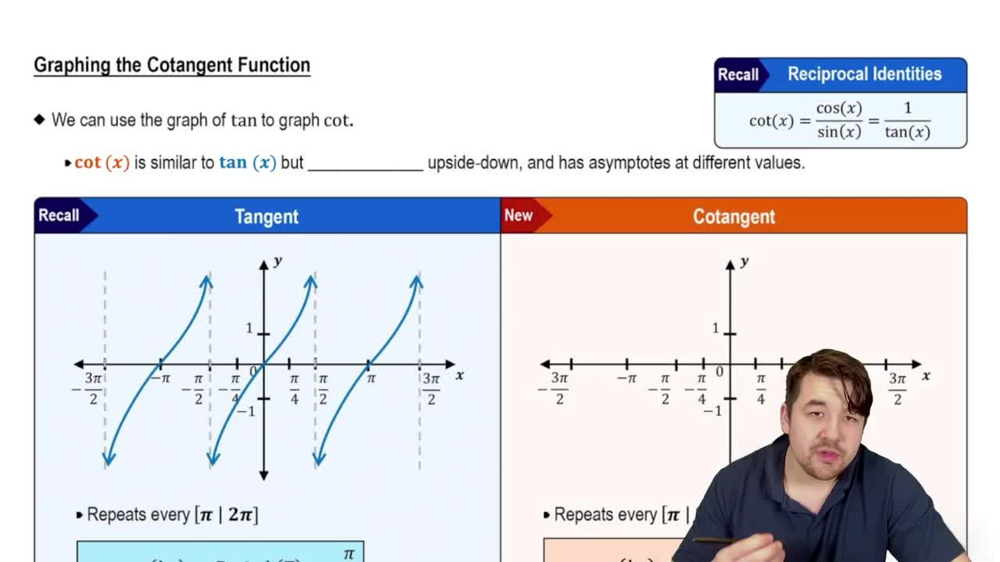
The cotangent function, cot θ, is the reciprocal of the tangent function: cot θ = 1/tan θ. It can also be expressed as the ratio of the adjacent side to the opposite side in a right triangle. Understanding cotangent is essential for recognizing its relationship with other trig functions.
Trigonometric identities allow substitution and simplification of expressions involving trig functions. By applying identities like complementary angle relationships, one can find equivalent expressions for unknown functions, enabling the completion of equations or simplification of expressions.

 Verified step by step guidance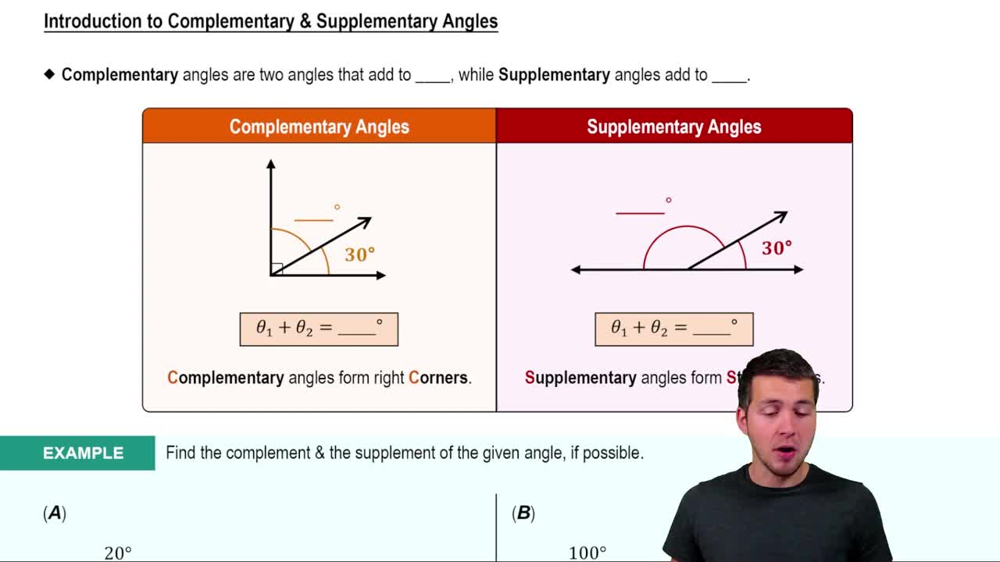
 3:35
3:35