Find one value of θ or x that satisfies each of the following. sec x = csc (2π/3)
Verified step by step guidance
1
Recall the definitions of the secant and cosecant functions: \(\sec x = \frac{1}{\cos x}\) and \(\csc y = \frac{1}{\sin y}\).
Rewrite the given equation \(\sec x = \csc \left( \frac{2\pi}{3} \right)\) as \(\frac{1}{\cos x} = \frac{1}{\sin \left( \frac{2\pi}{3} \right)}\).
Simplify the equation to \(\cos x = \sin \left( \frac{2\pi}{3} \right)\) by taking the reciprocal of both sides.
Evaluate \(\sin \left( \frac{2\pi}{3} \right)\) using the unit circle or known sine values for special angles.
Set \(\cos x\) equal to the value found in the previous step and solve for \(x\) by considering the general solutions for cosine, which are \(x = \pm \arccos(\text{value}) + 2k\pi\), where \(k\) is any integer.
Verified video answer for a similar problem:
This video solution was recommended by our tutors as helpful for the problem above
Play a video:
0 Comments
Key Concepts
Here are the essential concepts you must grasp in order to answer the question correctly.
Reciprocal Trigonometric Functions
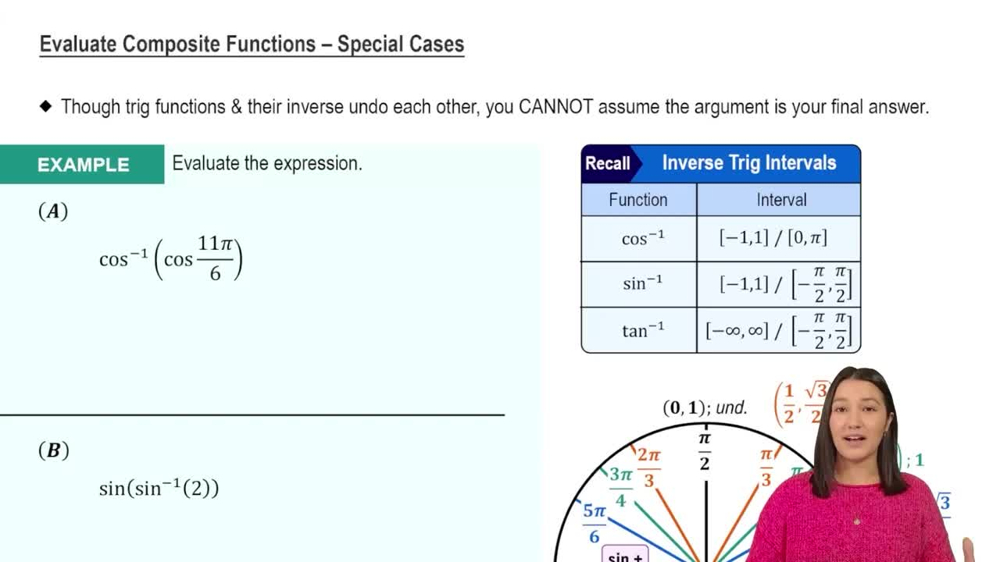
Secant (sec) and cosecant (csc) are reciprocal functions of cosine and sine, respectively. Specifically, sec x = 1/cos x and csc x = 1/sin x. Understanding these relationships helps convert the given equation into a more manageable form involving sine and cosine.
Evaluating Trigonometric Functions at Special Angles
The angle 2π/3 is a special angle in the unit circle, located in the second quadrant. Knowing the exact values of sine and cosine at this angle (sin 2π/3 = √3/2, cos 2π/3 = -1/2) allows precise evaluation of csc(2π/3), which is needed to solve the equation.
To find values of x satisfying sec x = csc(2π/3), rewrite the equation in terms of sine and cosine, then solve for x. This involves understanding the periodicity and domain of trigonometric functions to find valid solutions within a given interval.

 Verified step by step guidance
 6:04
6:04