A force of 25 lb is required to hold an 80-lb crate on a hill. What angle does the hill make with the horizontal?
Verified step by step guidance
1
Identify the forces acting on the crate on the hill: the weight of the crate (80 lb) acting vertically downward, and the force required to hold the crate in place (25 lb) acting parallel to the hill's surface.
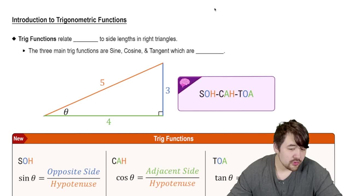
Recognize that the force holding the crate (25 lb) corresponds to the component of the crate's weight parallel to the hill's surface. This component can be expressed as \(F = W \sin(\theta)\), where \(W\) is the weight (80 lb) and \(\theta\) is the angle of the hill with the horizontal.
Set up the equation relating the given force to the weight component: \(25 = 80 \sin(\theta)\).
Solve for \(\sin(\theta)\) by dividing both sides of the equation by 80: \(\sin(\theta) = \frac{25}{80}\).
Find the angle \(\theta\) by taking the inverse sine (arcsin) of \(\frac{25}{80}\): \(\theta = \arcsin\left(\frac{25}{80}\right)\). This will give the angle the hill makes with the horizontal.
Verified video answer for a similar problem:
This video solution was recommended by our tutors as helpful for the problem above
Play a video:
0 Comments
Key Concepts
Here are the essential concepts you must grasp in order to answer the question correctly.
Resolving Forces on an Inclined Plane
When an object rests on a hill or inclined plane, its weight can be split into two components: one perpendicular to the surface and one parallel to it. The parallel component causes the object to slide down, and understanding this helps analyze the forces needed to hold the object in place.
The angle of the hill relates to the force components through sine, cosine, or tangent functions. Specifically, the tangent of the hill’s angle equals the ratio of the force parallel to the hill to the force perpendicular, allowing calculation of the angle from known forces.
For the crate to remain stationary, the forces acting along the hill must balance out. The applied force holding the crate equals the component of the crate’s weight pulling it down the slope, which is essential for setting up the equation to find the hill’s angle.

 Verified step by step guidance
 3:22
3:22