Two tugboats are pulling a disabled speedboat into port with forces of 1240 lb and 1480 lb. The angle between these forces is 28.2°. Find the direction and magnitude of the equilibrant.
Table of contents
- 0. Review of College Algebra4h 45m
- 1. Measuring Angles40m
- 2. Trigonometric Functions on Right Triangles2h 5m
- 3. Unit Circle1h 19m
- 4. Graphing Trigonometric Functions1h 19m
- 5. Inverse Trigonometric Functions and Basic Trigonometric Equations1h 41m
- 6. Trigonometric Identities and More Equations2h 34m
- 7. Non-Right Triangles1h 38m
- 8. Vectors2h 25m
- 9. Polar Equations2h 5m
- 10. Parametric Equations1h 6m
- 11. Graphing Complex Numbers1h 7m
8. Vectors
Geometric Vectors
Problem 34
Textbook Question
Two forces of 128 lb and 253 lb act on a point. The resultant force is 320 lb. Find the angle between the forces.
Verified step by step guidance1
Identify the given quantities: two forces with magnitudes \(F_1 = 128\) lb and \(F_2 = 253\) lb, and their resultant force \(R = 320\) lb. We need to find the angle \(\theta\) between these two forces.
Recall the law of cosines for vectors, which relates the magnitudes of two vectors and their resultant:
\(R^2 = F_1^2 + F_2^2 + 2 F_1 F_2 \cos(\theta)\)
Substitute the known values into the equation:
\(320^2 = 128^2 + 253^2 + 2 \times 128 \times 253 \times \cos(\theta)\)
Rearrange the equation to isolate \(\cos(\theta)\):
\(\cos(\theta) = \frac{320^2 - 128^2 - 253^2}{2 \times 128 \times 253}\)
Calculate the right-hand side value (without final numeric evaluation here), then use the inverse cosine function to find the angle:
\(\theta = \cos^{-1}(\text{value from previous step})\)
Verified video answer for a similar problem:This video solution was recommended by our tutors as helpful for the problem above
Play a video:
0 Comments
Key Concepts
Here are the essential concepts you must grasp in order to answer the question correctly.
Resultant of Two Forces
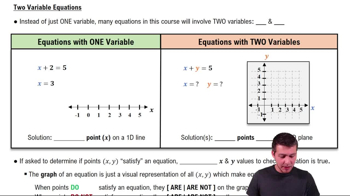
The resultant force is the single force that has the same effect as the two given forces acting together. It can be found using vector addition, considering both magnitude and direction of the forces.
Recommended video:
Equations with Two Variables
Law of Cosines in Vector Addition
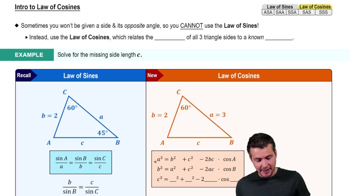
The law of cosines relates the magnitudes of two vectors and the angle between them to the magnitude of their resultant. It is expressed as R² = A² + B² - 2AB cos(θ), where θ is the angle between the forces.
Recommended video:
Intro to Law of Cosines
Solving for the Angle Between Forces
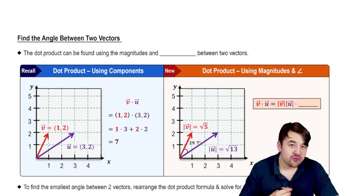
By rearranging the law of cosines formula, the angle between two forces can be found using θ = cos⁻¹((A² + B² - R²) / (2AB)). This allows determination of the angle when the magnitudes and resultant are known.
Recommended video:
Find the Angle Between Vectors
Related Videos
Related Practice
Textbook Question
815
views