Determine the simplest form of an equation for each graph. Choose b > 0, and include no phase shifts. (Midpoints and quarter points are identified by dots.)
<IMAGE>
Verified step by step guidance
1
Identify the type of trigonometric function represented by the graph (sine or cosine) by observing the starting point of the graph at x = 0. If the graph starts at a midpoint going upward, it is likely a sine function; if it starts at a maximum or minimum, it is likely a cosine function.
Determine the amplitude 'a' by measuring the vertical distance from the midline (usually y = 0) to the maximum or minimum point of the graph. The amplitude is the absolute value of this distance.
Find the period 'T' of the function by measuring the horizontal length of one complete cycle of the graph. The period is the distance between two consecutive points where the graph repeats its pattern (e.g., peak to peak or midpoint to midpoint).
Calculate the frequency 'b' using the formula \(b = \frac{2\pi}{T}\), where \(T\) is the period found in the previous step. Since the problem specifies \(b > 0\), ensure that the value is positive.
Write the equation in the form \(y = a \sin(bx)\) or \(y = a \cos(bx)\) without any phase shifts, using the amplitude 'a' and frequency 'b' determined above.
Verified video answer for a similar problem:
This video solution was recommended by our tutors as helpful for the problem above
Play a video:
0 Comments
Key Concepts
Here are the essential concepts you must grasp in order to answer the question correctly.
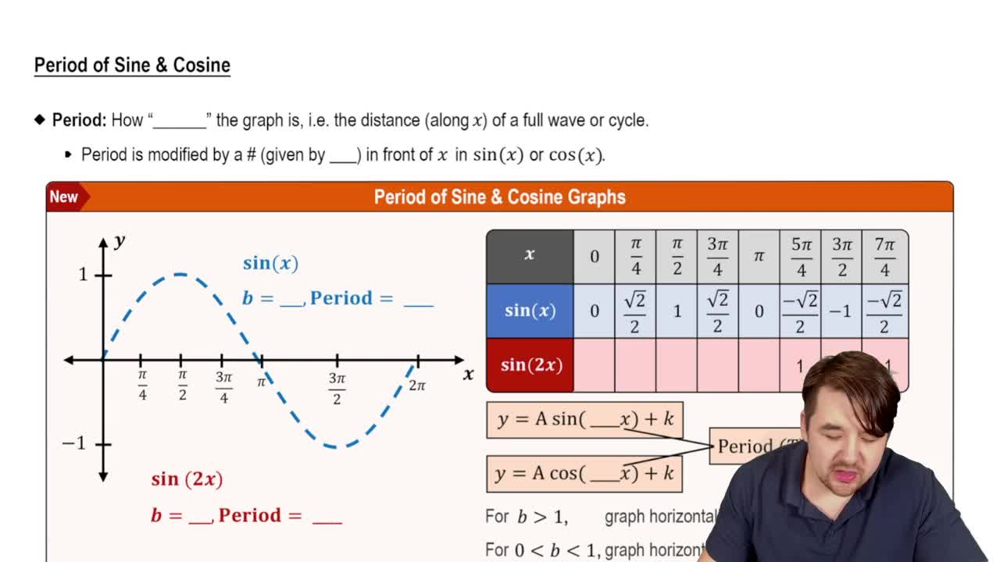
Basic Form of Sine and Cosine Functions
The general equations for sine and cosine functions are y = a sin(bx + c) + d and y = a cos(bx + c) + d, where a is amplitude, b affects the period, c is the phase shift, and d is the vertical shift. Understanding these parameters helps in matching the graph to its equation.
The period of sine and cosine functions is given by 2π/b, where b > 0 controls how many cycles occur in a 2π interval. Identifying the period from the graph allows determination of b, which is essential for writing the simplest form of the equation without phase shifts.
Amplitude is the distance from the midline to the peak of the wave, represented by |a|, and vertical shift d moves the midline up or down. Recognizing these from the graph’s midpoints and quarter points helps in accurately defining the equation’s parameters.

 Verified step by step guidance
 5:53
5:53