Find the degree measure of θ if it exists. Do not use a calculator. θ = arctan (-1)
Verified step by step guidance
1
Recall that the function \( \arctan(x) \) gives the angle \( \theta \) whose tangent is \( x \), and its range is \( \left(-\frac{\pi}{2}, \frac{\pi}{2}\right) \) or \( (-90^\circ, 90^\circ) \).
Set up the equation \( \tan(\theta) = -1 \) and think about angles where the tangent value is \( 1 \) or \( -1 \).
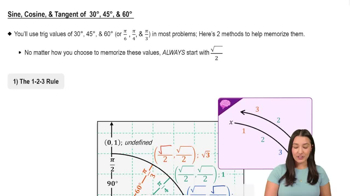
Remember that \( \tan(45^\circ) = 1 \), so the angle with tangent \( -1 \) in the range of \( \arctan \) must be the negative of \( 45^\circ \), because tangent is negative in the fourth quadrant (or negative angles).
Therefore, the angle \( \theta \) satisfying \( \arctan(-1) \) is \( -45^\circ \).
Express the answer as the degree measure \( \theta = -45^\circ \), which lies within the principal range of the \( \arctan \) function.
Verified video answer for a similar problem:
This video solution was recommended by our tutors as helpful for the problem above
Play a video:
0 Comments
Key Concepts
Here are the essential concepts you must grasp in order to answer the question correctly.
Inverse Trigonometric Functions
Inverse trigonometric functions, like arctan, return the angle whose trigonometric ratio equals a given value. For arctan(x), it gives the angle θ such that tan(θ) = x, typically within the principal range of -90° to 90°.
The tangent of an angle in a right triangle is the ratio of the opposite side to the adjacent side. Knowing common tangent values, such as tan(45°) = 1, helps identify angles when given a tangent value, including negative values indicating angles in specific quadrants.
Angles can be measured in degrees and lie in four quadrants. Since arctan returns angles between -90° and 90°, a negative tangent value corresponds to an angle in the fourth quadrant (negative angle) or first quadrant (positive angle), guiding the correct angle selection.

 Verified step by step guidance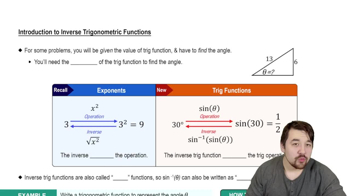
 4:28
4:28