Find the exact value of each expression. sin (π/12)
Verified step by step guidance
1
Recognize that \(\frac{\pi}{12}\) radians is equivalent to 15 degrees, which is not one of the standard angles with a simple sine value, so we use an angle sum or difference identity to find \(\sin\left(\frac{\pi}{12}\right)\).
Express \(\frac{\pi}{12}\) as a difference of two angles whose sine and cosine values are known, for example, \(\frac{\pi}{12} = \frac{\pi}{3} - \frac{\pi}{4}\).
Use the sine difference identity: \(\sin(a - b) = \sin a \cos b - \cos a \sin b\).
Substitute \(a = \frac{\pi}{3}\) and \(b = \frac{\pi}{4}\) into the identity to get \(\sin\left(\frac{\pi}{3} - \frac{\pi}{4}\right) = \sin\frac{\pi}{3} \cos\frac{\pi}{4} - \cos\frac{\pi}{3} \sin\frac{\pi}{4}\).
Recall the exact values: \(\sin\frac{\pi}{3} = \frac{\sqrt{3}}{2}\), \(\cos\frac{\pi}{4} = \frac{\sqrt{2}}{2}\), \(\cos\frac{\pi}{3} = \frac{1}{2}\), and \(\sin\frac{\pi}{4} = \frac{\sqrt{2}}{2}\). Substitute these into the expression to write the exact value.
Verified video answer for a similar problem:
This video solution was recommended by our tutors as helpful for the problem above
Play a video:
0 Comments
Key Concepts
Here are the essential concepts you must grasp in order to answer the question correctly.
Unit Circle and Radian Measure
The unit circle is a circle with radius 1 centered at the origin, used to define trigonometric functions for all angles. Radian measure relates the angle to the length of the arc on the unit circle, where π radians equal 180 degrees. Understanding π/12 radians helps locate the angle precisely on the unit circle.
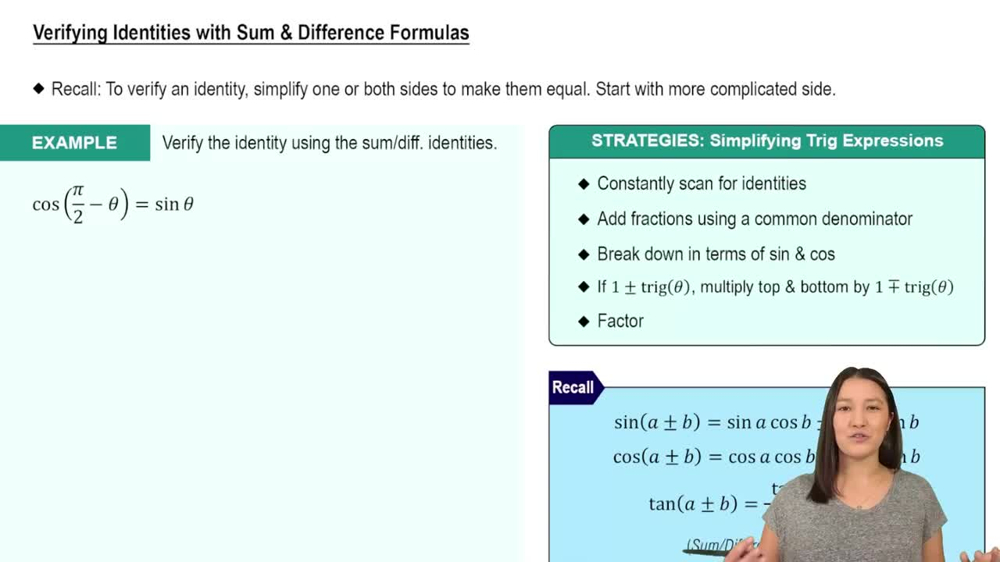
These identities express the sine or cosine of a sum or difference of angles in terms of sines and cosines of the individual angles. For example, sin(a ± b) = sin a cos b ± cos a sin b. This is useful for finding exact values of angles like π/12 by expressing them as sums or differences of known angles.
Verifying Identities with Sum and Difference Formulas
Exact Values of Special Angles
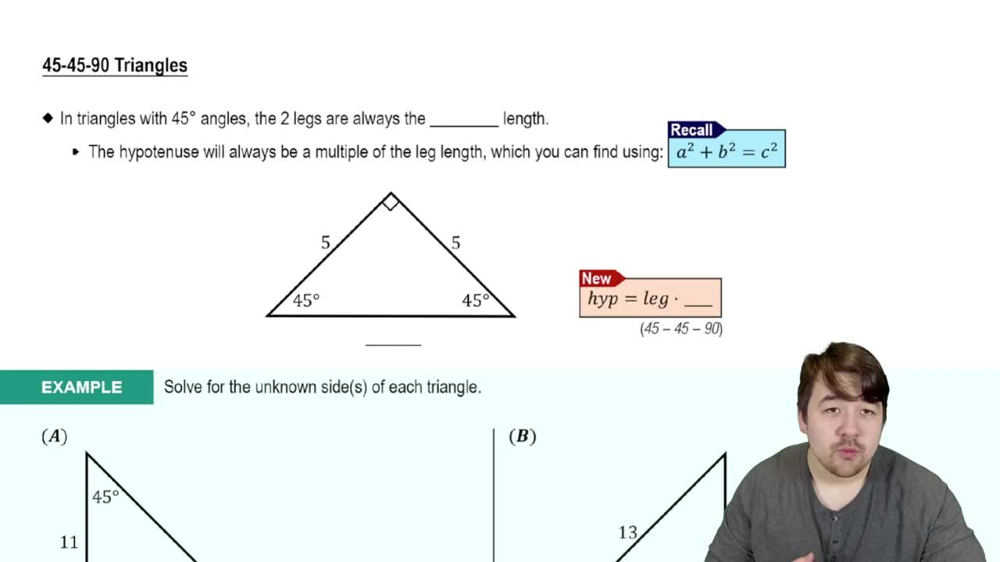
Certain angles such as π/6, π/4, and π/3 have known exact sine and cosine values. By expressing π/12 as a combination of these special angles (e.g., π/12 = π/4 - π/6), one can use their exact values to calculate sin(π/12) precisely without a calculator.

 Verified step by step guidance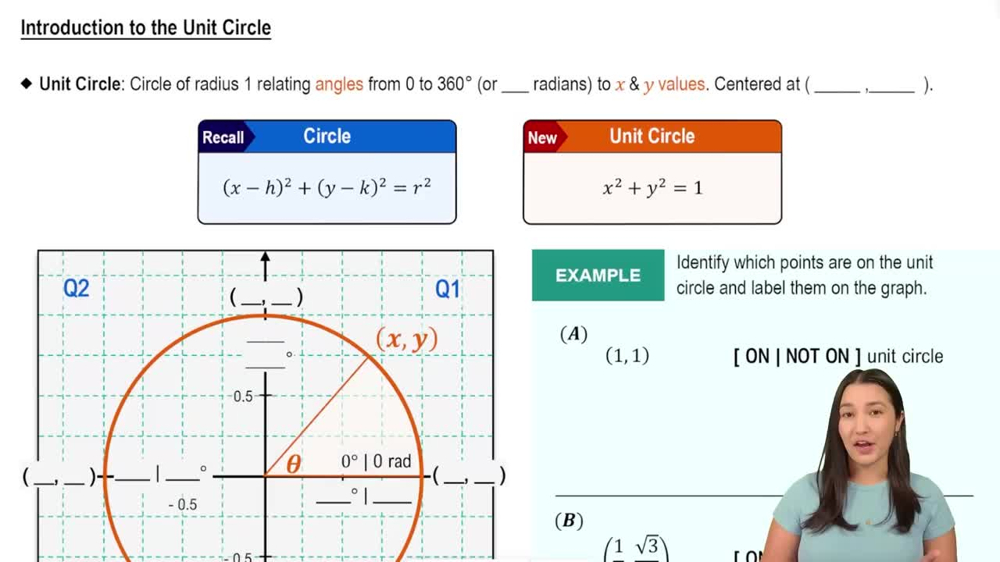
 06:11
06:11