In Exercises 7–12, find the radian measure of the central angle of a circle of radius r that intercepts an arc of length s. Radius, r: 6 yards Arc Length, s: 8 yards
Verified step by step guidance
1
Recall the formula that relates the arc length \( s \), radius \( r \), and central angle \( \theta \) in radians: \[ s = r \times \theta \].
Identify the given values: radius \( r = 6 \) yards and arc length \( s = 8 \) yards.
Substitute the known values into the formula: \[ 8 = 6 \times \theta \].
Solve for the central angle \( \theta \) by dividing both sides of the equation by 6: \[ \theta = \frac{8}{6} \].
Simplify the fraction if possible to express \( \theta \) in radians.
Verified video answer for a similar problem:
This video solution was recommended by our tutors as helpful for the problem above
Video duration:
2m
Play a video:
0 Comments
Key Concepts
Here are the essential concepts you must grasp in order to answer the question correctly.
Radian Measure of an Angle
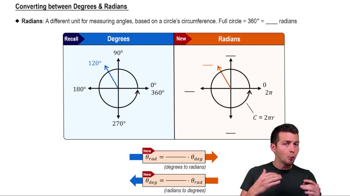
A radian is a unit of angular measure based on the radius of a circle. One radian is the angle subtended at the center of a circle by an arc whose length is equal to the radius. It provides a natural way to relate angles to arc lengths without converting to degrees.
Relationship Between Arc Length, Radius, and Central Angle
The central angle θ (in radians) of a circle is related to the arc length s and radius r by the formula θ = s / r. This formula allows you to find the angle when the arc length and radius are known, making it essential for solving problems involving circular arcs.
When calculating angles and lengths in trigonometry, it is important to ensure that all measurements are in consistent units. Here, both radius and arc length are given in yards, so no unit conversion is needed, simplifying the calculation of the radian measure.