In Exercises 29–36, simplify and write the result in standard form. ___ √−49
Table of contents
- 0. Review of College Algebra4h 45m
- 1. Measuring Angles40m
- 2. Trigonometric Functions on Right Triangles2h 5m
- 3. Unit Circle1h 19m
- 4. Graphing Trigonometric Functions1h 19m
- 5. Inverse Trigonometric Functions and Basic Trigonometric Equations1h 41m
- 6. Trigonometric Identities and More Equations2h 34m
- 7. Non-Right Triangles1h 38m
- 8. Vectors2h 25m
- 9. Polar Equations2h 5m
- 10. Parametric Equations1h 6m
- 11. Graphing Complex Numbers1h 7m
11. Graphing Complex Numbers
Graphing Complex Numbers
Problem 1
Textbook Question
In Exercises 1–10, perform the indicated operations and write the result in standard form. (8 − 3i) − (17 − 7i)
Verified step by step guidance1
Identify the problem as a subtraction of two complex numbers: \((8 - 3i) - (17 - 7i)\).
Recall that to subtract complex numbers, subtract their real parts and their imaginary parts separately.
Subtract the real parts: \$8 - 17$.
Subtract the imaginary parts: \(-3i - (-7i)\), which simplifies to \(-3i + 7i\).
Combine the results from the real and imaginary parts to write the answer in standard form \(a + bi\).
Verified video answer for a similar problem:This video solution was recommended by our tutors as helpful for the problem above
Video duration:
2mPlay a video:
0 Comments
Key Concepts
Here are the essential concepts you must grasp in order to answer the question correctly.
Complex Numbers and Standard Form
Complex numbers are expressed in the form a + bi, where a is the real part and b is the imaginary part. The standard form refers to writing the result explicitly as a sum of a real number and an imaginary number, making it easier to interpret and use in further calculations.
Recommended video:
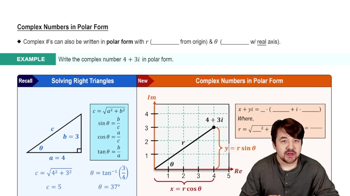
Complex Numbers In Polar Form
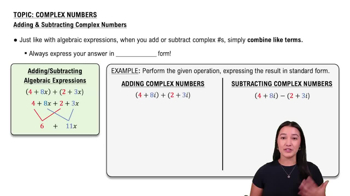
Addition and Subtraction of Complex Numbers
To add or subtract complex numbers, combine their real parts and their imaginary parts separately. For example, (a + bi) - (c + di) equals (a - c) + (b - d)i. This operation follows the same rules as combining like terms in algebra.
Recommended video:
Adding and Subtracting Complex Numbers
Imaginary Unit Properties
The imaginary unit i is defined such that i² = -1. Understanding this property is essential when simplifying expressions involving complex numbers, especially when multiplying or dividing, though it is less directly involved in simple addition or subtraction.
Recommended video:
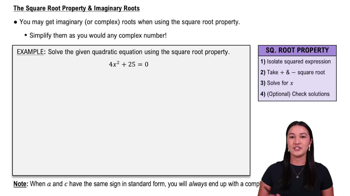
Imaginary Roots with the Square Root Property
Related Videos
Related Practice
Textbook Question
622
views