In Exercises 1–10, perform the indicated operations and write the result in standard form. (3 − 4i)²
Verified step by step guidance
1
Recall that to square a complex number in the form \((a + bi)\), you use the formula \((a + bi)^2 = a^2 + 2abi + (bi)^2\).
Identify the real part \(a = 3\) and the imaginary part \(b = -4\) from the complex number \((3 - 4i)\).
Apply the formula: calculate \(a^2 = 3^2\), \(2ab i = 2 \times 3 \times (-4) i\), and \((bi)^2 = (-4i)^2\) separately.
Remember that \(i^2 = -1\), so simplify \((bi)^2\) accordingly.
Combine the real parts and the imaginary parts to write the result in standard form \(x + yi\).
Verified video answer for a similar problem:
This video solution was recommended by our tutors as helpful for the problem above
Video duration:
2m
Play a video:
0 Comments
Key Concepts
Here are the essential concepts you must grasp in order to answer the question correctly.
Complex Numbers and Standard Form
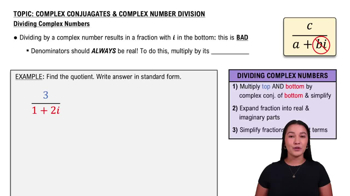
Complex numbers are expressed in the form a + bi, where a is the real part and b is the imaginary part. The standard form refers to writing the result explicitly as a sum of a real number and an imaginary number, making it easier to interpret and use in further calculations.
Squaring a complex number like (3 − 4i) involves applying the binomial formula (a − b)² = a² − 2ab + b². This requires careful handling of the imaginary unit i, remembering that i² = −1, which affects the sign and value of the terms.
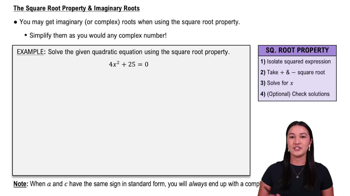
The imaginary unit i is defined such that i² = −1. This property is crucial when simplifying powers of i during operations with complex numbers, as it transforms terms involving i² into real numbers, enabling the expression to be written in standard form.

 2:36 minutes
 Verified step by step guidance
 04:47
04:47