In Exercises 61–64, find the magnitude ||v||, to the nearest hundredth, and the direction angle θ, to the nearest tenth of a degree, for each given vector v. v = -10i + 15j
Table of contents
- 0. Review of College Algebra4h 45m
- 1. Measuring Angles40m
- 2. Trigonometric Functions on Right Triangles2h 5m
- 3. Unit Circle1h 19m
- 4. Graphing Trigonometric Functions1h 19m
- 5. Inverse Trigonometric Functions and Basic Trigonometric Equations1h 41m
- 6. Trigonometric Identities and More Equations2h 34m
- 7. Non-Right Triangles1h 38m
- 8. Vectors2h 25m
- 9. Polar Equations2h 5m
- 10. Parametric Equations1h 6m
- 11. Graphing Complex Numbers1h 7m
8. Vectors
Geometric Vectors
Problem 15
Textbook Question
Refer to vectors a through h below. Make a copy or a sketch of each vector, and then draw a sketch to represent each of the following. For example, find a + e by placing a and e so that their initial points coincide. Then use the parallelogram rule to find the resultant, as shown in the figure on the right.
<IMAGE>
c + d
Verified step by step guidance1
Begin by sketching vectors \( \mathbf{c} \) and \( \mathbf{d} \) separately, ensuring you represent their directions and magnitudes accurately based on the given information or image.
Place the initial point of vector \( \mathbf{d} \) at the terminal point of vector \( \mathbf{c} \) to prepare for vector addition using the head-to-tail method.
Draw the resultant vector \( \mathbf{c} + \mathbf{d} \) starting from the initial point of \( \mathbf{c} \) to the terminal point of \( \mathbf{d} \) after it has been moved.
Alternatively, use the parallelogram rule by placing both vectors \( \mathbf{c} \) and \( \mathbf{d} \) with their initial points coinciding, then complete the parallelogram and draw the diagonal from the common initial point to find the resultant vector.
Label the resultant vector clearly on your sketch to represent \( \mathbf{c} + \mathbf{d} \), and verify the direction and magnitude visually or by calculation if coordinates or components are available.
0 Comments
Key Concepts
Here are the essential concepts you must grasp in order to answer the question correctly.
Vector Addition
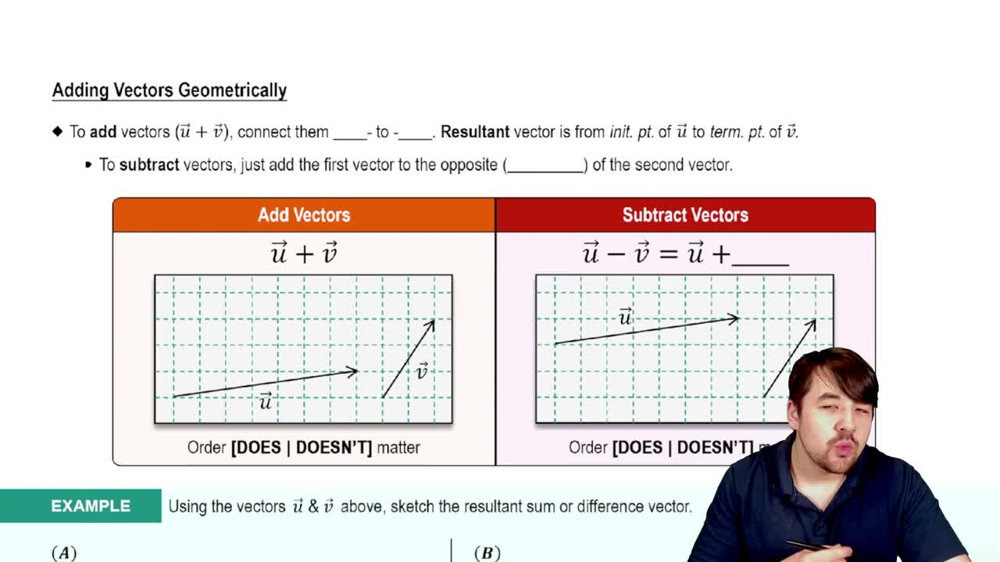
Vector addition involves combining two or more vectors to produce a resultant vector. This is done by placing the initial point of one vector at the terminal point of another and then drawing the vector from the start of the first to the end of the last. It is essential for understanding how to combine vectors like c and d.
Recommended video:
Adding Vectors Geometrically
Parallelogram Rule
The parallelogram rule is a geometric method to add two vectors. By placing both vectors so their initial points coincide, a parallelogram is formed using the vectors as adjacent sides. The diagonal of this parallelogram from the common initial point represents the resultant vector.
Recommended video:
Sine, Cosine, & Tangent of 30°, 45°, & 60°
Vector Representation and Sketching
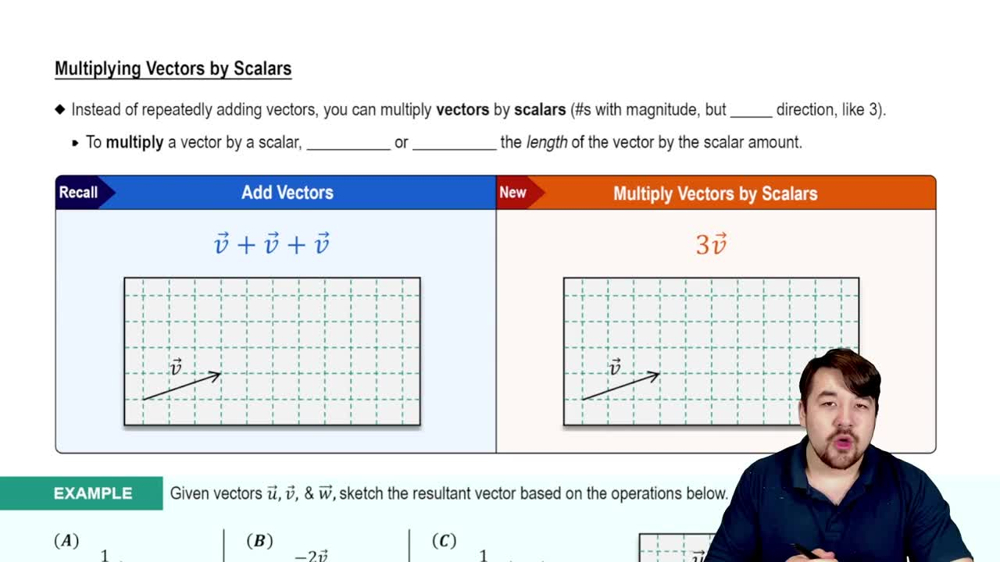
Accurately sketching vectors involves drawing arrows with correct direction and relative magnitude. This visual representation helps in understanding vector operations like addition and subtraction. Sketching vectors c and d correctly is crucial for applying the parallelogram rule effectively.
Recommended video:
Multiplying Vectors By Scalars
Related Videos
Related Practice
Textbook Question
725
views