If P₁ = (-2, 3), P₂ = (-1, 5), and v is the vector from P₁ to P₂, Write v in terms of i and j.
Verified step by step guidance
1
Identify the coordinates of points P₁ and P₂: P₁ = (-2, 3) and P₂ = (-1, 5).
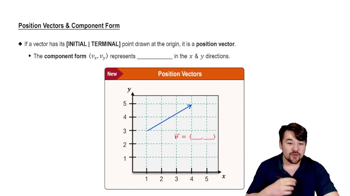
Recall that the vector \( \mathbf{v} \) from point P₁ to point P₂ is found by subtracting the coordinates of P₁ from P₂: \( \mathbf{v} = (x_2 - x_1, y_2 - y_1) \).
Calculate the difference in the x-coordinates: \( x_2 - x_1 = -1 - (-2) \).
Calculate the difference in the y-coordinates: \( y_2 - y_1 = 5 - 3 \).
Express the vector \( \mathbf{v} \) in terms of the unit vectors \( \mathbf{i} \) and \( \mathbf{j} \) as \( \mathbf{v} = (x_2 - x_1)\mathbf{i} + (y_2 - y_1)\mathbf{j} \).
Verified video answer for a similar problem:
This video solution was recommended by our tutors as helpful for the problem above
Video duration:
2m
Play a video:
0 Comments
Key Concepts
Here are the essential concepts you must grasp in order to answer the question correctly.
Vector Representation in the Plane
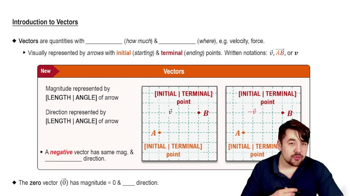
A vector in the plane can be represented as a combination of unit vectors i and j, which point in the directions of the x-axis and y-axis respectively. This allows any vector to be expressed as v = ai + bj, where a and b are the components along the x and y axes.
The vector from point P₁ to point P₂ is found by subtracting the coordinates of P₁ from P₂. Specifically, if P₁ = (x₁, y₁) and P₂ = (x₂, y₂), then the vector v = (x₂ - x₁, y₂ - y₁), representing the displacement from P₁ to P₂.
The component form expresses a vector as an ordered pair of its horizontal and vertical components. Writing v = ai + bj means the vector has a horizontal component a along i and a vertical component b along j, making it easier to perform vector operations and visualize direction and magnitude.

 2:05 minutes
 Verified step by step guidance
 03:48
03:48