In Exercises 63–84, use an identity to solve each equation on the interval [0, 2𝝅). 4 cos² x = 5 - 4 sin x
Verified step by step guidance
1
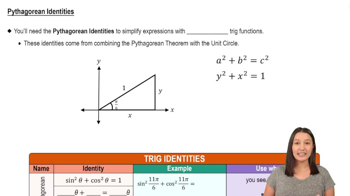
Start by recalling the Pythagorean identity: \(\cos^{2} x = 1 - \sin^{2} x\). This allows us to rewrite the equation in terms of \(\sin x\) only.
Substitute \(\cos^{2} x\) with \(1 - \sin^{2} x\) in the equation: \(4(1 - \sin^{2} x) = 5 - 4 \sin x\).
Expand the left side: \(4 - 4 \sin^{2} x = 5 - 4 \sin x\).
Bring all terms to one side to form a quadratic equation in \(\sin x\): \(-4 \sin^{2} x + 4 \sin x + 4 - 5 = 0\), which simplifies to \(-4 \sin^{2} x + 4 \sin x - 1 = 0\).
Multiply the entire equation by \(-1\) to make the quadratic coefficient positive: \(4 \sin^{2} x - 4 \sin x + 1 = 0\). Now, solve this quadratic equation for \(\sin x\) using the quadratic formula.
Verified video answer for a similar problem:
This video solution was recommended by our tutors as helpful for the problem above
Video duration:
5m
Play a video:
0 Comments
Key Concepts
Here are the essential concepts you must grasp in order to answer the question correctly.
Pythagorean Identity
The Pythagorean identity states that sin²x + cos²x = 1 for any angle x. This identity allows you to express cos²x in terms of sin²x or vice versa, which is essential for rewriting the given equation into a single trigonometric function to simplify solving.
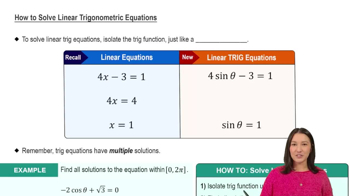
Solving trigonometric equations involves manipulating the equation using identities and algebraic techniques to isolate the trigonometric function. Then, find all angle solutions within the specified interval by considering the unit circle and periodicity of sine and cosine.
When solving trigonometric equations, solutions must be found within a given interval, here [0, 2π). This requires understanding the unit circle and how sine and cosine values repeat every 2π, ensuring all valid solutions in the interval are identified and extraneous ones discarded.