In Exercises 63–84, use an identity to solve each equation on the interval [0, 2𝝅). cos 2x + 5 cos x + 3 = 0
Verified step by step guidance
1
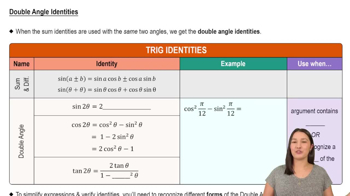
Recognize that the equation involves \( \cos 2x \) and \( \cos x \). Use the double-angle identity for cosine: \( \cos 2x = 2\cos^2 x - 1 \).
Substitute \( \cos 2x \) in the equation with the identity to rewrite the equation entirely in terms of \( \cos x \): \( 2\cos^2 x - 1 + 5\cos x + 3 = 0 \).
Simplify the equation by combining like terms: \( 2\cos^2 x + 5\cos x + 2 = 0 \).
Let \( y = \cos x \) to transform the trigonometric equation into a quadratic equation: \( 2y^2 + 5y + 2 = 0 \).
Solve the quadratic equation for \( y \) using the quadratic formula \( y = \frac{-b \pm \sqrt{b^2 - 4ac}}{2a} \), then find all \( x \) in \( [0, 2\pi) \) such that \( \cos x = y \).
Verified video answer for a similar problem:
This video solution was recommended by our tutors as helpful for the problem above
Video duration:
4m
Play a video:
0 Comments
Key Concepts
Here are the essential concepts you must grasp in order to answer the question correctly.
Double-Angle Identity for Cosine
The double-angle identity expresses cos(2x) in terms of cos(x) or sin(x). Common forms include cos(2x) = 2cos²(x) - 1 or cos(2x) = 1 - 2sin²(x). This identity allows rewriting the equation to involve only one trigonometric function, simplifying the solving process.
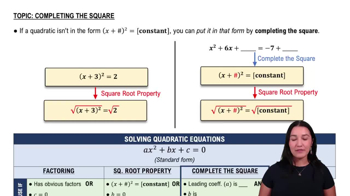
After applying identities, the equation often becomes quadratic in terms of cos(x) or sin(x). Solving involves treating the trigonometric function as a variable, factoring or using the quadratic formula, and then finding all angle solutions within the given interval.
Solving Quadratic Equations by Completing the Square
Finding Solutions on a Specified Interval
Trigonometric equations can have multiple solutions within an interval like [0, 2π). It is essential to find all angles that satisfy the equation in this range, considering the periodicity of cosine and verifying each solution to ensure it lies within the interval.