Use a polar coordinate system like the one shown for Exercises 1–10 to plot each point with the given polar coordinates. (3, 90°)
Table of contents
- 0. Review of College Algebra4h 45m
- 1. Measuring Angles40m
- 2. Trigonometric Functions on Right Triangles2h 5m
- 3. Unit Circle1h 19m
- 4. Graphing Trigonometric Functions1h 19m
- 5. Inverse Trigonometric Functions and Basic Trigonometric Equations1h 41m
- 6. Trigonometric Identities and More Equations2h 34m
- 7. Non-Right Triangles1h 38m
- 8. Vectors2h 25m
- 9. Polar Equations2h 5m
- 10. Parametric Equations1h 6m
- 11. Graphing Complex Numbers1h 7m
9. Polar Equations
Polar Coordinate System
Problem 15
Textbook Question
In Exercises 13–34, test for symmetry and then graph each polar equation. r = 1 − sin θ
Verified step by step guidance1
Recall the three common tests for symmetry in polar equations: symmetry about the polar axis (x-axis), symmetry about the line \( \theta = \frac{\pi}{2} \) (y-axis), and symmetry about the pole (origin).
To test for symmetry about the polar axis, replace \( \theta \) with \( -\theta \) in the equation \( r = 1 - \sin \theta \) and check if the equation remains unchanged.
To test for symmetry about the line \( \theta = \frac{\pi}{2} \), replace \( \theta \) with \( \pi - \theta \) and check if the equation remains unchanged.
To test for symmetry about the pole, replace \( r \) with \( -r \) and \( \theta \) with \( \theta + \pi \) and check if the equation remains unchanged.
After determining the symmetries, plot points for various values of \( \theta \) (for example, \( 0, \frac{\pi}{6}, \frac{\pi}{4}, \frac{\pi}{2}, \pi \), etc.) by calculating corresponding \( r \) values using \( r = 1 - \sin \theta \), then sketch the graph accordingly.
Verified video answer for a similar problem:This video solution was recommended by our tutors as helpful for the problem above
Video duration:
6mPlay a video:
0 Comments
Key Concepts
Here are the essential concepts you must grasp in order to answer the question correctly.
Polar Coordinates and Equations
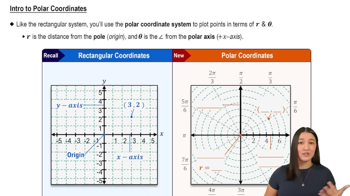
Polar coordinates represent points using a radius r and an angle θ from the positive x-axis. Polar equations express r as a function of θ, describing curves in the plane. Understanding how to interpret and plot these equations is essential for graphing polar curves.
Recommended video:
Intro to Polar Coordinates
Symmetry Tests in Polar Graphs
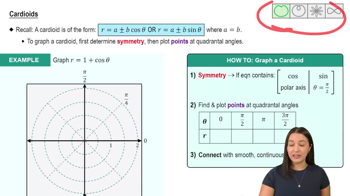
Symmetry in polar graphs can be tested about the polar axis, the line θ = π/2, and the pole (origin). These tests involve substituting θ with -θ, π - θ, or replacing r with -r to check if the equation remains unchanged, helping to simplify graphing and understand the curve's shape.
Recommended video:
Cardioids
Graphing Polar Equations Involving Sine
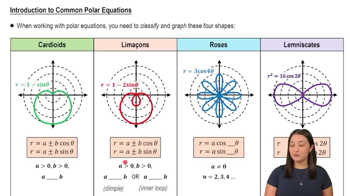
Polar equations with sine functions, like r = 1 − sin θ, often produce limaçon or cardioid shapes. Recognizing the effect of the sine term on the radius as θ varies helps in sketching the curve accurately, noting key points such as maximum and minimum r values.
Recommended video:
Introduction to Common Polar Equations
Related Videos
Related Practice
Textbook Question
730
views