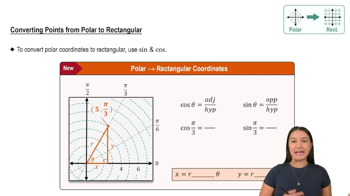
Use a polar coordinate system like the one shown for Exercises 1–10 to plot each point with the given polar coordinates. (3, 90°)
Verified step by step guidance
1
Understand that the polar coordinates are given in the form \((r, \theta)\), where \(r\) is the distance from the origin and \(\theta\) is the angle measured from the positive x-axis (polar axis) in degrees.
Identify the given coordinates: \(r = 3\) and \(\theta = 90^\circ\). This means the point is 3 units away from the origin at an angle of \(90^\circ\).
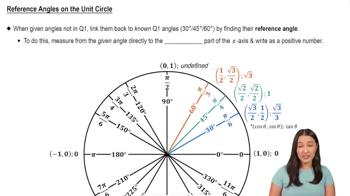
Recall that an angle of \(90^\circ\) corresponds to the positive y-axis in the Cartesian coordinate system.
To plot the point, start at the origin, rotate counterclockwise by \(90^\circ\), and then move 3 units along that direction.
Mark the point at this location on the polar coordinate system, which lies directly above the origin on the vertical axis.
Verified video answer for a similar problem:
This video solution was recommended by our tutors as helpful for the problem above
Video duration:
1m
Play a video:
0 Comments
Key Concepts
Here are the essential concepts you must grasp in order to answer the question correctly.
Polar Coordinate System
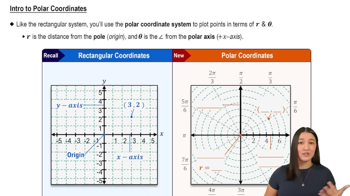
The polar coordinate system represents points in a plane using a distance from a fixed origin (radius r) and an angle θ measured from a reference direction, usually the positive x-axis. Each point is expressed as (r, θ), where r ≥ 0 and θ is typically in degrees or radians.
To plot a point given in polar coordinates (r, θ), start at the origin, rotate counterclockwise by the angle θ, then move outward along that direction by the distance r. For example, (3, 90°) means move 3 units upward since 90° corresponds to the positive y-axis.
Angles in polar coordinates are often measured in degrees, where 0° points along the positive x-axis, and angles increase counterclockwise. Understanding this convention is essential for correctly locating points, such as recognizing that 90° points straight up along the positive y-axis.

 1:22 minutes
 Verified step by step guidance
 05:32
05:32