Find the exact value of each real number y if it exists. Do not use a calculator. y = arcsin (―√3/2)
Verified step by step guidance
1
Recall that the function \(\arcsin(x)\) gives the angle \(y\) in the interval \([-\frac{\pi}{2}, \frac{\pi}{2}]\) such that \(\sin(y) = x\).
Identify the value inside the arcsin function: \(x = -\frac{\sqrt{3}}{2}\). We need to find an angle \(y\) where \(\sin(y) = -\frac{\sqrt{3}}{2}\).
Recall the common sine values: \(\sin\left(\frac{\pi}{3}\right) = \frac{\sqrt{3}}{2}\). Since the sine is negative, the angle must be in the fourth or third quadrant, but \(\arcsin\) only returns values in \([-\frac{\pi}{2}, \frac{\pi}{2}]\) (first and fourth quadrants).
Since \(\sin(y) = -\frac{\sqrt{3}}{2}\) and \(y\) is in \([-\frac{\pi}{2}, 0]\) (fourth quadrant), the angle is \(y = -\frac{\pi}{3}\).
Therefore, the exact value of \(y\) satisfying \(y = \arcsin\left(-\frac{\sqrt{3}}{2}\right)\) is \(y = -\frac{\pi}{3}\).
Verified video answer for a similar problem:
This video solution was recommended by our tutors as helpful for the problem above
Play a video:
0 Comments
Key Concepts
Here are the essential concepts you must grasp in order to answer the question correctly.
Definition of arcsin (Inverse Sine Function)
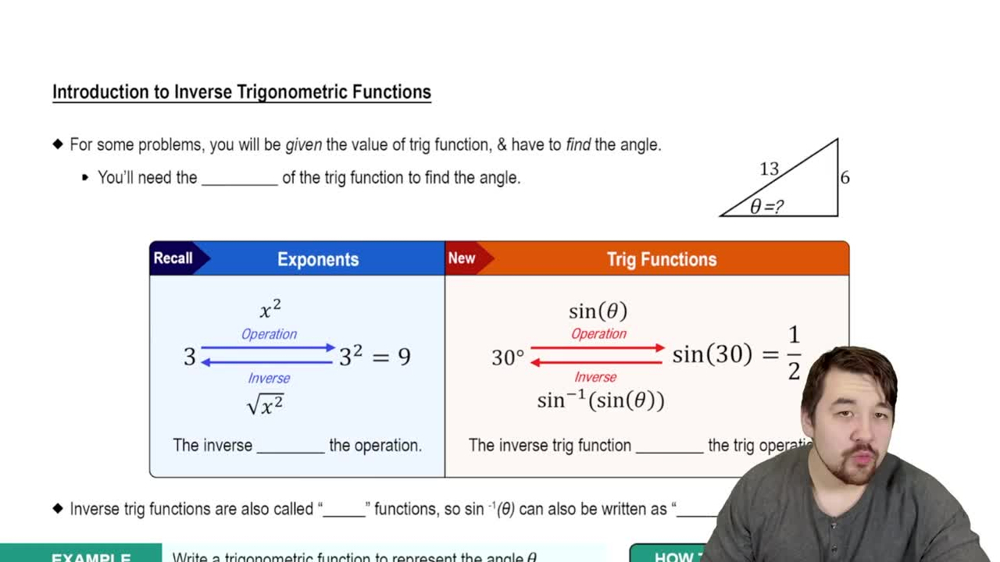
The arcsin function is the inverse of the sine function, returning the angle whose sine is a given number. Its output range is limited to [-π/2, π/2], meaning it only returns angles in the first and fourth quadrants. Understanding this range is crucial for finding the correct angle corresponding to a sine value.
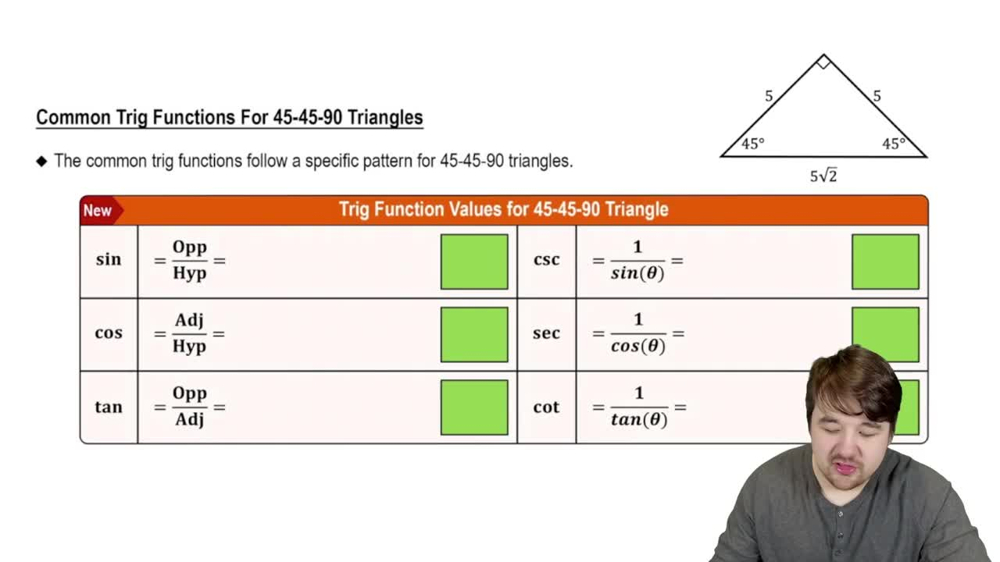
Certain angles have well-known sine values, such as π/6, π/4, and π/3. For example, sin(π/3) = √3/2. Recognizing these exact values helps in determining the angle when given a sine value like -√3/2, by considering the sign and the reference angle.
Sign and Quadrant Considerations for Inverse Trigonometric Functions
Since arcsin outputs angles only between -π/2 and π/2, negative sine values correspond to angles in the fourth quadrant (negative angles). For y = arcsin(-√3/2), the angle is negative and matches the reference angle π/3, resulting in y = -π/3.

 Verified step by step guidance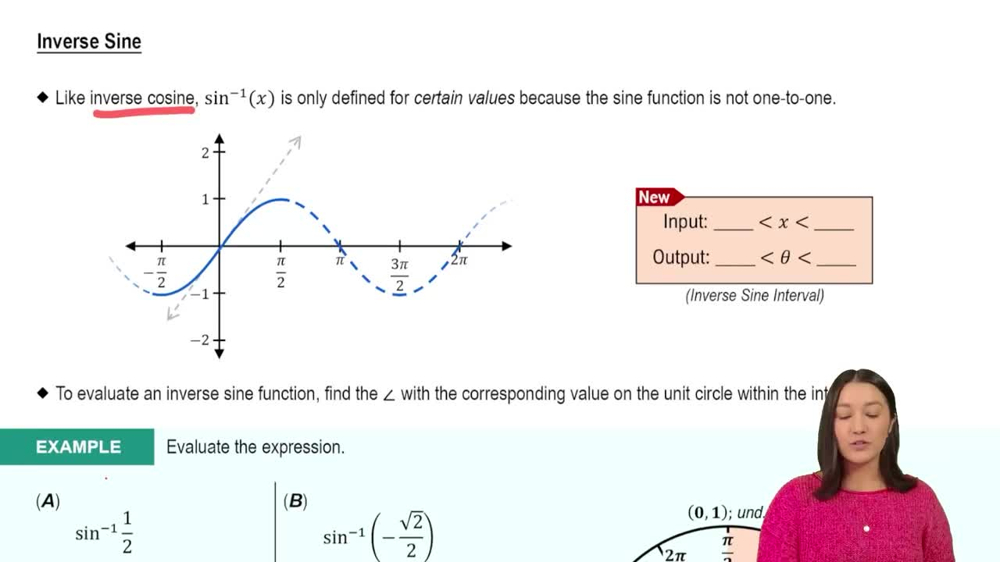
 4:03
4:03