Find the exact value of each real number y if it exists. Do not use a calculator. y = sin⁻¹ √3
Verified step by step guidance
1
Recall the domain of the inverse sine function \(\sin^{-1}(x)\), which is \([-1, 1]\). This means the input to \(\sin^{-1}\) must be between \(-1\) and \$1$ inclusive.
Check the value inside the inverse sine function: \(\sqrt{3}\). Since \(\sqrt{3} \approx 1.732\), it is greater than \$1$.
Since \(\sqrt{3}\) is outside the domain of \(\sin^{-1}\), there is no real number \(y\) such that \(y = \sin^{-1}(\sqrt{3})\).
Therefore, the problem has no solution in the set of real numbers because the input to \(\sin^{-1}\) is invalid.
If you want to explore complex solutions, that would involve extending the inverse sine function to complex numbers, but for real numbers, no solution exists.
Verified video answer for a similar problem:
This video solution was recommended by our tutors as helpful for the problem above
Play a video:
0 Comments
Key Concepts
Here are the essential concepts you must grasp in order to answer the question correctly.
Inverse Sine Function (sin⁻¹ or arcsin)
The inverse sine function, sin⁻¹(x), returns the angle whose sine is x. Its output range is limited to [-π/2, π/2] to ensure it is a function. Understanding this helps find the angle y such that sin(y) equals the given value.
The sine function outputs values only between -1 and 1, so the input to sin⁻¹ must lie within this range. Since √3 is approximately 1.732, which is outside this domain, no real y satisfies sin(y) = √3, indicating no real solution exists.
Common exact sine values include sin(π/6) = 1/2, sin(π/4) = √2/2, and sin(π/3) = √3/2. Recognizing these helps identify if the given value corresponds to a known angle. Since √3 is not among these values, it further confirms no exact real angle exists for sin⁻¹(√3).

 Verified step by step guidance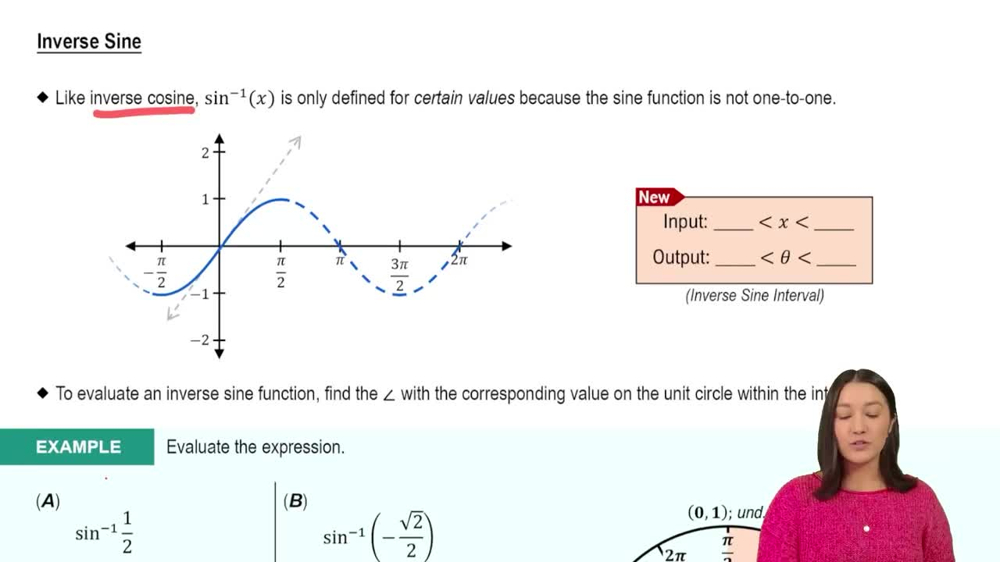
 4:03
4:03