Which of the following best describes the graph of the polar equation ?
Table of contents
- 0. Review of College Algebra4h 45m
- 1. Measuring Angles40m
- 2. Trigonometric Functions on Right Triangles2h 5m
- 3. Unit Circle1h 19m
- 4. Graphing Trigonometric Functions1h 19m
- 5. Inverse Trigonometric Functions and Basic Trigonometric Equations1h 41m
- 6. Trigonometric Identities and More Equations2h 34m
- 7. Non-Right Triangles1h 38m
- 8. Vectors2h 25m
- 9. Polar Equations2h 5m
- 10. Parametric Equations1h 6m
- 11. Graphing Complex Numbers1h 7m
9. Polar Equations
Graphing Other Common Polar Equations
Problem 5.RE.65
Textbook Question
In Exercises 64–70, graph each polar equation. Be sure to test for symmetry. r = 2 + 2 sin θ
Verified step by step guidance1
Identify the given polar equation: \(r = 2 + 2 \sin \theta\).
Recall that \(r\) represents the radius (distance from the origin) and \(\theta\) is the angle measured from the positive x-axis in polar coordinates.
Test for symmetry by checking the following:
- Symmetry about the polar axis (x-axis): Replace \(\theta\) with \(-\theta\) and see if the equation remains unchanged.
- Symmetry about the line \(\theta = \frac{\pi}{2}\) (y-axis): Replace \(\theta\) with \(\pi - \theta\).
- Symmetry about the pole (origin): Replace \(r\) with \(-r\) and \(\theta\) with \(\theta + \pi\).
Create a table of values by choosing several values of \(\theta\) (for example, \$0\(, \(\frac{\pi}{6}\), \(\frac{\pi}{4}\), \(\frac{\pi}{2}\), etc.) and calculate the corresponding \)r$ values using the equation \(r = 2 + 2 \sin \theta\).
Plot the points \((r, \theta)\) on polar graph paper or using a graphing tool, then connect the points smoothly to visualize the curve. Observe the shape and symmetry based on your earlier tests.
Verified video answer for a similar problem:This video solution was recommended by our tutors as helpful for the problem above
Video duration:
6mPlay a video:
0 Comments
Key Concepts
Here are the essential concepts you must grasp in order to answer the question correctly.
Polar Coordinates and Equations
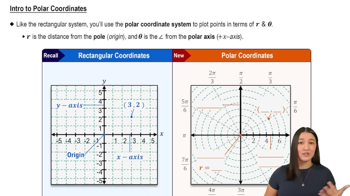
Polar coordinates represent points in a plane using a radius and an angle (r, θ) instead of Cartesian coordinates (x, y). A polar equation expresses the radius r as a function of the angle θ, allowing the graph to be plotted by calculating r for various θ values.
Recommended video:
Intro to Polar Coordinates
Graphing Polar Equations
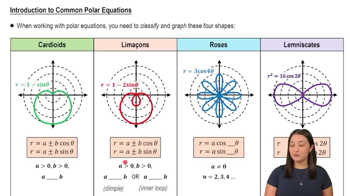
To graph a polar equation like r = 2 + 2 sin θ, calculate r for multiple θ values between 0 and 2π, then plot the points in polar form. Connecting these points reveals the shape, which often corresponds to known curves such as limacons or cardioids.
Recommended video:
Introduction to Common Polar Equations
Symmetry in Polar Graphs
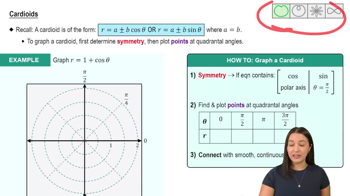
Testing for symmetry helps simplify graphing and understanding polar curves. Common symmetries include symmetry about the polar axis (θ = 0), the line θ = π/2, and the pole (origin). Checking if replacing θ with -θ, π - θ, or θ + π yields the same equation indicates these symmetries.
Recommended video:
Cardioids
Related Videos
Related Practice
Multiple Choice
70
views