Given the limaçon , find the area that lies inside the larger loop and outside the smaller loop.
Table of contents
- 0. Review of College Algebra4h 45m
- 1. Measuring Angles40m
- 2. Trigonometric Functions on Right Triangles2h 5m
- 3. Unit Circle1h 19m
- 4. Graphing Trigonometric Functions1h 19m
- 5. Inverse Trigonometric Functions and Basic Trigonometric Equations1h 41m
- 6. Trigonometric Identities and More Equations2h 34m
- 7. Non-Right Triangles1h 38m
- 8. Vectors2h 25m
- 9. Polar Equations2h 5m
- 10. Parametric Equations1h 6m
- 11. Graphing Complex Numbers1h 7m
9. Polar Equations
Graphing Other Common Polar Equations
Problem 43
Textbook Question
In Exercises 35–44, test for symmetry and then graph each polar equation. r = 2 + 3 sin 2θ
Verified step by step guidance1
Recall the three types of symmetry tests for polar equations: symmetry about the polar axis (x-axis), symmetry about the line \( \theta = \frac{\pi}{2} \) (y-axis), and symmetry about the pole (origin).
To test symmetry about the polar axis, replace \( \theta \) with \( -\theta \) in the equation and check if the equation remains unchanged. For \( r = 2 + 3 \sin 2\theta \), substitute \( -\theta \) to get \( r = 2 + 3 \sin(-2\theta) \).
To test symmetry about the line \( \theta = \frac{\pi}{2} \), replace \( \theta \) with \( \pi - \theta \) and check if the equation remains unchanged. Substitute \( \pi - \theta \) into the equation to get \( r = 2 + 3 \sin 2(\pi - \theta) \).
To test symmetry about the pole (origin), replace \( r \) with \( -r \) and \( \theta \) with \( \theta + \pi \), then check if the equation remains unchanged. Substitute these into the equation to get \( -r = 2 + 3 \sin 2(\theta + \pi) \).
After determining the symmetries, sketch the graph by plotting points for various values of \( \theta \) between 0 and \( 2\pi \), calculating corresponding \( r \) values using the equation \( r = 2 + 3 \sin 2\theta \), and then plotting these points in polar coordinates.
Verified video answer for a similar problem:This video solution was recommended by our tutors as helpful for the problem above
Video duration:
5mPlay a video:
0 Comments
Key Concepts
Here are the essential concepts you must grasp in order to answer the question correctly.
Polar Coordinates and Equations
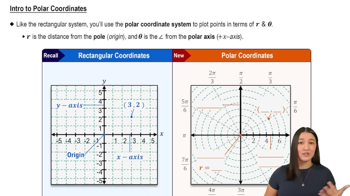
Polar coordinates represent points using a radius r and an angle θ from the positive x-axis. Polar equations express r as a function of θ, describing curves in the plane. Understanding how to interpret and plot these equations is essential for graphing polar curves.
Recommended video:
Intro to Polar Coordinates
Symmetry Tests in Polar Graphs
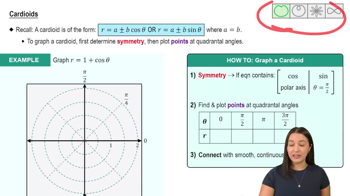
Symmetry in polar graphs can be tested about the polar axis, the line θ = π/2, and the pole (origin). These tests involve substituting θ with -θ, π - θ, or replacing r with -r to check if the equation remains unchanged, helping to identify symmetrical properties of the curve.
Recommended video:
Cardioids
Trigonometric Functions in Polar Equations
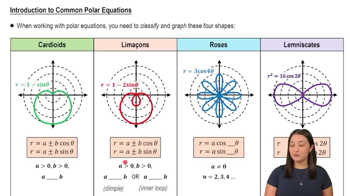
Polar equations often include trigonometric functions like sine and cosine, which influence the shape and periodicity of the graph. Recognizing how functions like sin(2θ) affect the curve's lobes and symmetry is crucial for accurate graphing and analysis.
Recommended video:
Introduction to Common Polar Equations
Related Videos
Related Practice
Multiple Choice
62
views