In Exercises 23β34, find the exact value of each of the remaining trigonometric functions of ΞΈ. sec ΞΈ = -3, tan ΞΈ > 0
Table of contents
- 0. Review of College Algebra4h 45m
- 1. Measuring Angles40m
- 2. Trigonometric Functions on Right Triangles2h 5m
- 3. Unit Circle1h 19m
- 4. Graphing Trigonometric Functions1h 19m
- 5. Inverse Trigonometric Functions and Basic Trigonometric Equations1h 41m
- 6. Trigonometric Identities and More Equations2h 34m
- 7. Non-Right Triangles1h 38m
- 8. Vectors2h 25m
- 9. Polar Equations2h 5m
- 10. Parametric Equations1h 6m
- 11. Graphing Complex Numbers1h 7m
2. Trigonometric Functions on Right Triangles
Trigonometric Functions on Right Triangles
Problem 41
Textbook Question
In Exercises 33β42, let sin t = a, cos t = b, and tan t = c. Write each expression in terms of a, b, and c.
cos t + cos(t + 1000π) - tan t - tan(t + 999π) - sin t + 4 sin(t - 1000π)
Verified step by step guidance1
Recall the periodic properties of sine, cosine, and tangent functions: sine and cosine have a period of \(2\pi\), and tangent has a period of \(\pi\). This means \(\sin(t + 2k\pi) = \sin t\), \(\cos(t + 2k\pi) = \cos t\), and \(\tan(t + k\pi) = \tan t\) for any integer \(k\).
Simplify each trigonometric term with the given large multiples of \(\pi\) using the periodicity:
- \(\cos(t + 1000\pi)\) can be rewritten using the fact that \(1000\pi = 500 \times 2\pi\), so \(\cos(t + 1000\pi) = \cos t\).
- \(\tan(t + 999\pi)\) can be rewritten using \(999\pi = 999 \times \pi\), so \(\tan(t + 999\pi) = \tan t\).
- \(\sin(t - 1000\pi)\) can be rewritten as \(\sin(t - 1000\pi) = \sin t\) because \(-1000\pi = -500 \times 2\pi\).
Substitute the simplified expressions back into the original expression:
\(\cos t + \cos t - \tan t - \tan t - \sin t + 4 \sin t\).
Group like terms together:
Combine the cosine terms: \(\cos t + \cos t = 2b\) (since \(\cos t = b\)).
Combine the tangent terms: \(-\tan t - \tan t = -2c\) (since \(\tan t = c\)).
Combine the sine terms: \(-\sin t + 4 \sin t = 3a\) (since \(\sin t = a\)).
Write the final simplified expression in terms of \(a\), \(b\), and \(c\):
\$2b - 2c + 3a$.
Verified video answer for a similar problem:This video solution was recommended by our tutors as helpful for the problem above
Video duration:
6mPlay a video:
0 Comments
Key Concepts
Here are the essential concepts you must grasp in order to answer the question correctly.
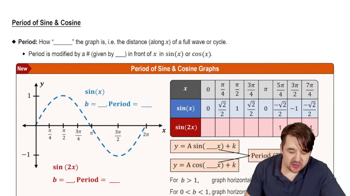
Periodic Properties of Trigonometric Functions
Sine, cosine, and tangent functions repeat their values in regular intervals called periods. For sine and cosine, the period is 2Ο, meaning sin(t + 2Ο) = sin t and cos(t + 2Ο) = cos t. Tangent has a period of Ο, so tan(t + Ο) = tan t. Understanding these periodicities allows simplification of expressions involving large multiples of Ο.
Recommended video:
Period of Sine and Cosine Functions
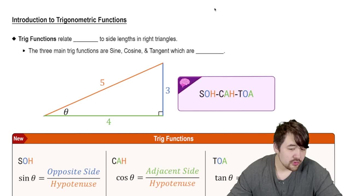
Trigonometric Function Definitions and Relationships
The functions sine (sin t), cosine (cos t), and tangent (tan t) are related by tan t = sin t / cos t. Knowing these definitions helps express complex trigonometric expressions in terms of given variables a, b, and c. This relationship is essential for rewriting and simplifying expressions involving multiple trigonometric terms.
Recommended video:
Introduction to Trigonometric Functions
Angle Addition and Subtraction Formulas
The angle addition and subtraction formulas express trigonometric functions of sums or differences of angles in terms of functions of individual angles. For example, cos(t + ΞΈ) = cos t cos ΞΈ - sin t sin ΞΈ. These formulas are useful for breaking down expressions like cos(t + 1000Ο) or sin(t - 1000Ο) into simpler terms involving sin t and cos t.
Recommended video:
Adding and Subtracting Complex Numbers
Related Videos
Related Practice
Textbook Question
540
views