
Textbook Question
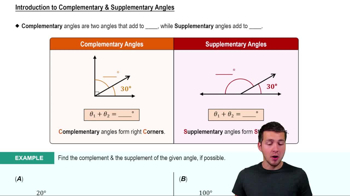
Find the measure of (a) the complement and (b) the supplement of an angle with the given measure. See Examples 1 and 3. 54°
696
views

 Verified step by step guidance
 2:20
2:20
 3:35
3:35 04:42
04:42Find the measure of (a) the complement and (b) the supplement of an angle with the given measure. See Examples 1 and 3. 54°
Sketch an angle θ in standard position such that θ has the least positive measure, and the given point is on the terminal side of θ. Then find the values of the six trigonometric functions for each angle. Rationalize denominators when applicable. See Examples 1, 2, and 4. (―8 , 15)
Find the measure of (a) the complement and (b) the supplement of an angle with the given measure. See Examples 1 and 3. 10°
Use the appropriate reciprocal identity to find each function value. Rationalize denominators when applicable. See Example 1. cot θ , given that tan θ = 18
Find the measure of each marked angle. In Exercises 19–22, m and n are parallel. See Examples 1 and 2 .
Solve each problem. Length of a Road A camera is located on a satellite with its lens positioned at C in the figure. Length PC represents the distance from the lens to the film PQ, and BA represents a straight road on the ground. Use the measurements given in the figure to find the length of the road. (Data from Kastner, B., Space Mathematics, NASA.)