Calculate the missing side of the triangle below.
Table of contents
- 0. Review of College Algebra4h 45m
- 1. Measuring Angles40m
- 2. Trigonometric Functions on Right Triangles2h 5m
- 3. Unit Circle1h 19m
- 4. Graphing Trigonometric Functions1h 19m
- 5. Inverse Trigonometric Functions and Basic Trigonometric Equations1h 41m
- 6. Trigonometric Identities and More Equations2h 34m
- 7. Non-Right Triangles1h 38m
- 8. Vectors2h 25m
- 9. Polar Equations2h 5m
- 10. Parametric Equations1h 6m
- 11. Graphing Complex Numbers1h 7m
0. Review of College Algebra
Pythagorean Theorem & Basics of Triangles
Problem 13
Textbook Question
Find the measure of each marked angle. In Exercises 19–22, m and n are parallel. See Examples 1 and 2 .
<IMAGE>
Verified step by step guidance1
Identify the given information: lines m and n are parallel, and there are marked angles formed by a transversal crossing these parallel lines.
Recall that when a transversal crosses two parallel lines, corresponding angles are equal, alternate interior angles are equal, and consecutive interior angles are supplementary (sum to 180 degrees).
Use the properties of parallel lines and the transversal to set up equations relating the marked angles. For example, if two angles are corresponding angles, set their measures equal: \(\angle A = \angle B\).
If the problem involves supplementary angles (angles on the same side of the transversal inside the parallel lines), use the equation \(\angle A + \angle B = 180^\circ\) to relate their measures.
Solve the resulting equations step-by-step to find the measure of each marked angle, expressing each angle in terms of known values or variables given in the problem.
Verified video answer for a similar problem:This video solution was recommended by our tutors as helpful for the problem above
Video duration:
3mPlay a video:
0 Comments
Key Concepts
Here are the essential concepts you must grasp in order to answer the question correctly.
Parallel Lines and Transversals
When two parallel lines are cut by a transversal, several angle relationships are formed, such as corresponding, alternate interior, and alternate exterior angles. These relationships help determine unknown angle measures by establishing equality or supplementary conditions.
Recommended video:
Example 1
Angle Relationships
Key angle pairs include corresponding angles (equal), alternate interior angles (equal), and consecutive interior angles (supplementary). Understanding these relationships allows solving for unknown angles when parallel lines and a transversal are involved.
Recommended video:
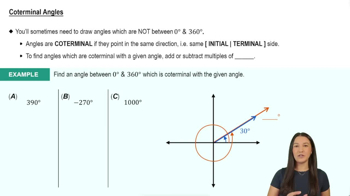
Coterminal Angles
Using Algebra to Solve for Angles
Often, marked angles are expressed in algebraic terms. Setting up equations based on angle relationships and solving for variables enables finding the exact measure of each angle, combining geometric reasoning with algebraic manipulation.
Recommended video:
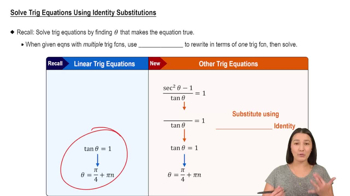
Solve Trig Equations Using Identity Substitutions
Related Videos
Related Practice
Multiple Choice
742
views
7
rank