Write each expression as the sine, cosine, or tangent of a double angle. Then find the exact value of the expression. 2cos² 𝝅/8﹣ 1
Verified step by step guidance
1
Recognize that the given expression is of the form \(\cos^2 x - 1\), where \(x = \frac{\pi}{8}\). Recall the double-angle identity for cosine: \(\cos 2x = 2\cos^2 x - 1\).
Rearrange the double-angle identity to express \(\cos^2 x - 1\) in terms of \(\cos 2x\): starting from \(\cos 2x = 2\cos^2 x - 1\), subtract 1 from both sides and then isolate \(\cos^2 x - 1\).
Express \(\cos^2 x - 1\) as \(\frac{\cos 2x - 1}{2}\) by manipulating the identity: \(\cos 2x = 2\cos^2 x - 1 \Rightarrow 2\cos^2 x = \cos 2x + 1 \Rightarrow \cos^2 x = \frac{\cos 2x + 1}{2}\), so \(\cos^2 x - 1 = \frac{\cos 2x + 1}{2} - 1\).
Simplify the expression \(\cos^2 x - 1\) to \(\frac{\cos 2x - 1}{2}\), which is now written as a cosine double-angle expression.
Substitute \(x = \frac{\pi}{8}\) into the double-angle expression to get \(\frac{\cos \left(2 \times \frac{\pi}{8}\right) - 1}{2} = \frac{\cos \frac{\pi}{4} - 1}{2}\). Then, use the exact value of \(\cos \frac{\pi}{4}\) to find the exact value of the original expression.
Verified video answer for a similar problem:
This video solution was recommended by our tutors as helpful for the problem above
Video duration:
2m
Play a video:
0 Comments
Key Concepts
Here are the essential concepts you must grasp in order to answer the question correctly.
Double-Angle Identities
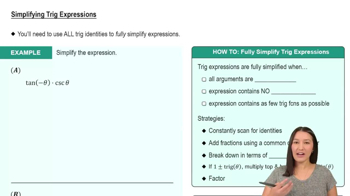
Double-angle identities express trigonometric functions of twice an angle in terms of functions of the original angle. For example, cos(2θ) = 2cos²θ - 1 or cos(2θ) = 1 - 2sin²θ. These identities help rewrite expressions like cos²(θ) in terms of cos(2θ), simplifying evaluation.
Exact values refer to precise trigonometric values for special angles, often expressed in terms of square roots and fractions. Angles like π/8 or π/4 have known exact sine, cosine, and tangent values, which are essential for finding exact results without decimal approximations.
Simplifying trigonometric expressions involves rewriting them using identities to reduce complexity. This includes converting powers of sine or cosine into single trigonometric functions of multiple angles, enabling easier evaluation and clearer understanding of the expression.