CONCEPT PREVIEW Assume a triangle ABC has standard labeling.
a. Determine whether SAA, ASA, SSA, SAS, or SSS is given.
b. Determine whether the law of sines or the law of cosines should be used to begin solving the triangle.
a, b, and C
Verified step by step guidance
1
Identify the given parts of the triangle: sides \( a \) and \( b \), and angle \( C \). Since two sides and the included angle are given, this corresponds to the SAS (Side-Angle-Side) case.
Recall the definitions of the triangle congruence cases: SAA (two angles and a side), ASA (angle-side-angle), SSA (side-side-angle), SAS (side-angle-side), and SSS (side-side-side). Here, the angle \( C \) is between sides \( a \) and \( b \), confirming SAS.
For SAS, the Law of Cosines is the appropriate tool to use first because it relates two sides and the included angle to find the third side. The Law of Cosines formula is: \[ c^2 = a^2 + b^2 - 2ab \cos(C) \].
Use the Law of Cosines to find the unknown side \( c \) by substituting the known values of \( a \), \( b \), and \( C \) into the formula.
After finding side \( c \), you can use the Law of Sines or other methods to find the remaining angles or sides as needed.
Verified video answer for a similar problem:
This video solution was recommended by our tutors as helpful for the problem above
Play a video:
0 Comments
Key Concepts
Here are the essential concepts you must grasp in order to answer the question correctly.
These criteria describe how triangles can be determined or solved based on known sides and angles. SAA (or AAS) and ASA involve two angles and one side, SAS involves two sides and the included angle, SSS involves all three sides, and SSA involves two sides and a non-included angle, which can be ambiguous.
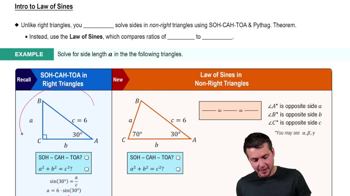
The Law of Sines relates the ratios of sides to the sines of their opposite angles in any triangle. It is especially useful when two angles and one side (AAS or ASA) or two sides and a non-included angle (SSA) are known, allowing for the calculation of unknown sides or angles.
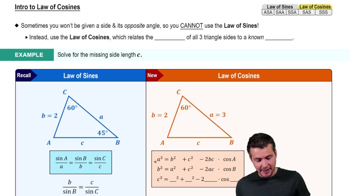
The Law of Cosines generalizes the Pythagorean theorem for any triangle, relating the lengths of sides to the cosine of an included angle. It is typically used when two sides and the included angle (SAS) or all three sides (SSS) are known, enabling the calculation of unknown sides or angles.

 Verified step by step guidance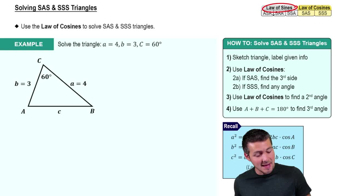
 7:50
7:50