A ship is sailing due north. At a certain point the bearing of a lighthouse 12.5 km away is N 38.8° E. Later on, the captain notices that the bearing of the lighthouse has become S 44.2° E. How far did the ship travel between the two observations of the lighthouse?
Table of contents
- 0. Review of College Algebra4h 45m
- 1. Measuring Angles40m
- 2. Trigonometric Functions on Right Triangles2h 5m
- 3. Unit Circle1h 19m
- 4. Graphing Trigonometric Functions1h 19m
- 5. Inverse Trigonometric Functions and Basic Trigonometric Equations1h 41m
- 6. Trigonometric Identities and More Equations2h 34m
- 7. Non-Right Triangles1h 38m
- 8. Vectors2h 25m
- 9. Polar Equations2h 5m
- 10. Parametric Equations1h 6m
- 11. Graphing Complex Numbers1h 7m
7. Non-Right Triangles
Law of Sines
Problem 26
Textbook Question
In Exercises 17–32, two sides and an angle (SSA) of a triangle are given. Determine whether the given measurements produce one triangle, two triangles, or no triangle at all. Solve each triangle that results. Round to the nearest tenth and the nearest degree for sides and angles, respectively.
a = 30, b = 40, A = 20°
Verified step by step guidance1
Identify the given elements: side \(a = 30\), side \(b = 40\), and angle \(A = 20^\circ\). Since we have two sides and a non-included angle (SSA), this is the ambiguous case in triangle solving.
Use the Law of Sines to find the possible value(s) of angle \(B\). The Law of Sines states: \(\frac{a}{\sin A} = \frac{b}{\sin B}\). Rearranged to find \(\sin B\), we get \(\sin B = \frac{b \sin A}{a}\).
Calculate \(\sin B\) using the values given: \(\sin B = \frac{40 \times \sin 20^\circ}{30}\). Then determine if \(\sin B\) is less than, equal to, or greater than 1 to decide the number of possible triangles:
- If \(\sin B > 1\), no triangle exists.
- If \(\sin B = 1\), exactly one right triangle exists.
- If \(\sin B < 1\), there may be one or two triangles depending on the angle values.
If \(\sin B < 1\), find angle \(B\) by taking \(B = \sin^{-1}(\sin B)\). Then find the second possible angle \(B' = 180^\circ - B\) to check if a second triangle is possible (since sine is positive in both the first and second quadrants).
For each valid triangle, find the third angle \(C\) using the angle sum property: \(C = 180^\circ - A - B\) (or \(C = 180^\circ - A - B'\) for the second triangle). Then use the Law of Sines again to find side \(c\): \(c = \frac{a \sin C}{\sin A}\). Round all sides to the nearest tenth and angles to the nearest degree.
Verified video answer for a similar problem:This video solution was recommended by our tutors as helpful for the problem above
Video duration:
9mPlay a video:
0 Comments
Key Concepts
Here are the essential concepts you must grasp in order to answer the question correctly.
Law of Sines
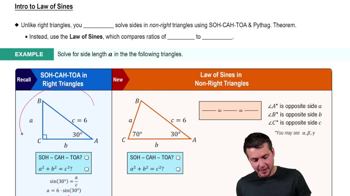
The Law of Sines relates the ratios of the lengths of sides of a triangle to the sines of their opposite angles. It is essential for solving triangles when two sides and a non-included angle (SSA) are given, allowing calculation of unknown angles or sides.
Recommended video:
Intro to Law of Sines
Ambiguous Case of SSA Triangles
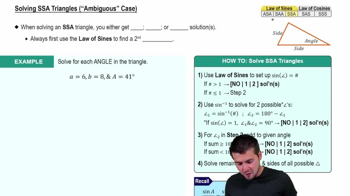
The SSA configuration can produce zero, one, or two possible triangles depending on the given measurements. This ambiguity arises because the given angle and side may correspond to different triangle configurations, requiring careful analysis to determine the number of solutions.
Recommended video:
Solving SSA Triangles ("Ambiguous" Case)
Triangle Solution and Rounding
After determining the number of triangles, solving involves finding all missing sides and angles using trigonometric laws. Final answers should be rounded appropriately—sides to the nearest tenth and angles to the nearest degree—to provide clear, practical results.
Recommended video:
30-60-90 Triangles
Related Videos
Related Practice
Textbook Question
1271
views