Use a calculator to find each value. Give answers as real numbers. tan (arcsin 0.12251014)
Verified step by step guidance
1
Recognize that the expression is \( \tan(\arcsin(0.12251014)) \). Here, \( \arcsin(0.12251014) \) represents an angle \( \theta \) whose sine is 0.12251014.
Set \( \theta = \arcsin(0.12251014) \), so by definition, \( \sin(\theta) = 0.12251014 \). Our goal is to find \( \tan(\theta) \).
Recall the Pythagorean identity: \( \sin^2(\theta) + \cos^2(\theta) = 1 \). Use this to find \( \cos(\theta) \) by calculating \( \cos(\theta) = \sqrt{1 - \sin^2(\theta)} \).
Once you have \( \cos(\theta) \), use the definition of tangent: \( \tan(\theta) = \frac{\sin(\theta)}{\cos(\theta)} \). Substitute the known values to express \( \tan(\theta) \).
Finally, use a calculator to evaluate the numerical value of \( \tan(\arcsin(0.12251014)) \) by performing the square root and division operations.
Verified video answer for a similar problem:
This video solution was recommended by our tutors as helpful for the problem above
Play a video:
0 Comments
Key Concepts
Here are the essential concepts you must grasp in order to answer the question correctly.
Inverse Trigonometric Functions
Inverse trigonometric functions, like arcsin, return the angle whose trigonometric ratio matches a given value. For example, arcsin(0.12251014) gives the angle whose sine is 0.12251014, typically measured in radians or degrees.
The tangent of an angle can be expressed in terms of sine and cosine: tan(θ) = sin(θ)/cos(θ). Knowing the sine value allows calculation of cosine using the Pythagorean identity, enabling the evaluation of tangent for the given angle.
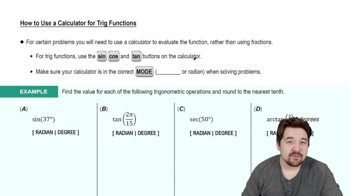
Calculators can compute inverse trigonometric functions and standard trigonometric functions accurately. Using a calculator, one can find arcsin values and then apply tangent to the resulting angle, ensuring answers are given as real numbers.

 Verified step by step guidance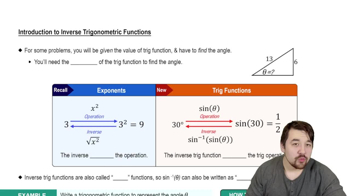
 4:28
4:28