Two forces act on a point in the plane. The angle between the two forces is given. Find the magnitude of the resultant force. forces of 116 and 139 lb, forming an angle of 140° 50′
Verified step by step guidance
1
Identify the magnitudes of the two forces: \(F_1 = 116\) lb and \(F_2 = 139\) lb, and the angle between them: \(\theta = 140^\circ 50'\).
Convert the angle from degrees and minutes to decimal degrees for easier calculation: \(140^\circ 50' = 140 + \frac{50}{60} = 140.8333^\circ\) approximately.
Recall the formula for the magnitude of the resultant force \(R\) when two forces act at an angle \(\theta\):
\(R = \sqrt{F_1^2 + F_2^2 + 2 F_1 F_2 \cos(\theta)}\)
Substitute the known values into the formula:
\(R = \sqrt{116^2 + 139^2 + 2 \times 116 \times 139 \times \cos(140.8333^\circ)}\)
Calculate the cosine of the angle \(\cos(140.8333^\circ)\), then evaluate the expression inside the square root, and finally take the square root to find the magnitude of the resultant force.
Verified video answer for a similar problem:
This video solution was recommended by our tutors as helpful for the problem above
Play a video:
0 Comments
Key Concepts
Here are the essential concepts you must grasp in order to answer the question correctly.
Vector Addition of Forces
Forces acting at a point can be represented as vectors. The resultant force is the vector sum of the individual forces, combining both magnitude and direction to find the overall effect on the point.
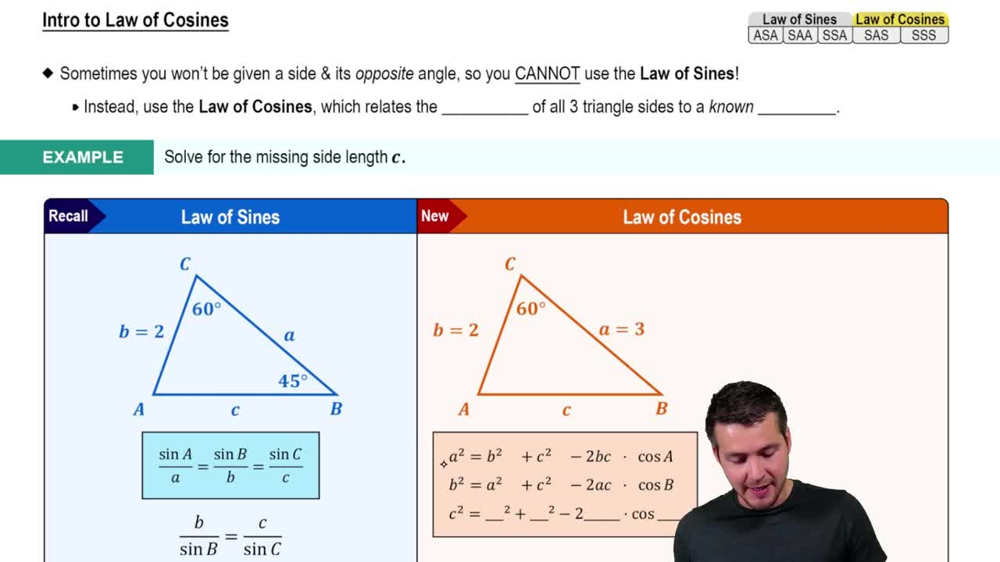
The law of cosines relates the lengths of sides in a triangle to the cosine of one angle. It is used to find the magnitude of the resultant vector when two vectors and the angle between them are known.
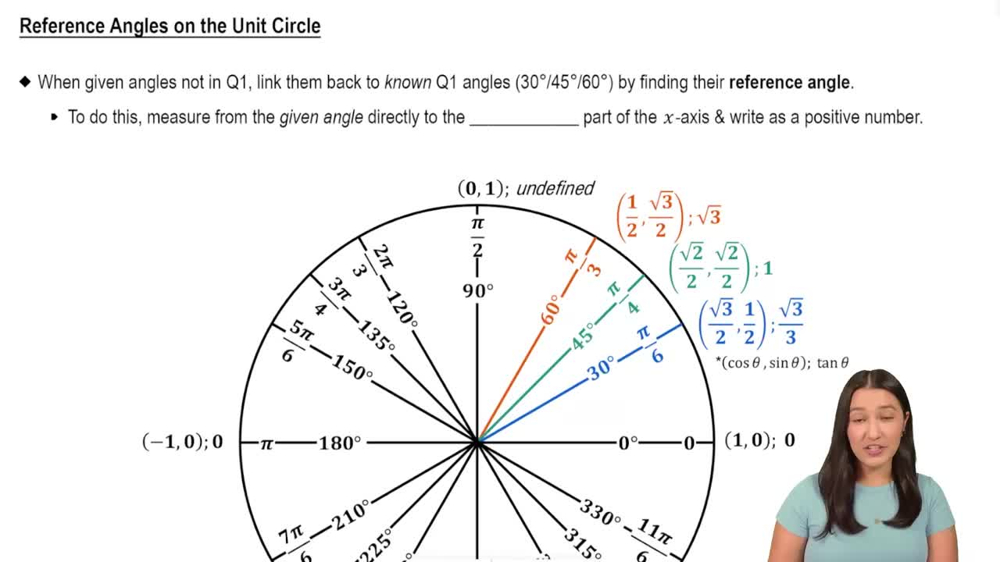
Angles given in degrees and minutes must be accurately converted to decimal degrees or radians for calculations. Precise angle measurement ensures correct application of trigonometric formulas like the law of cosines.

 Verified step by step guidance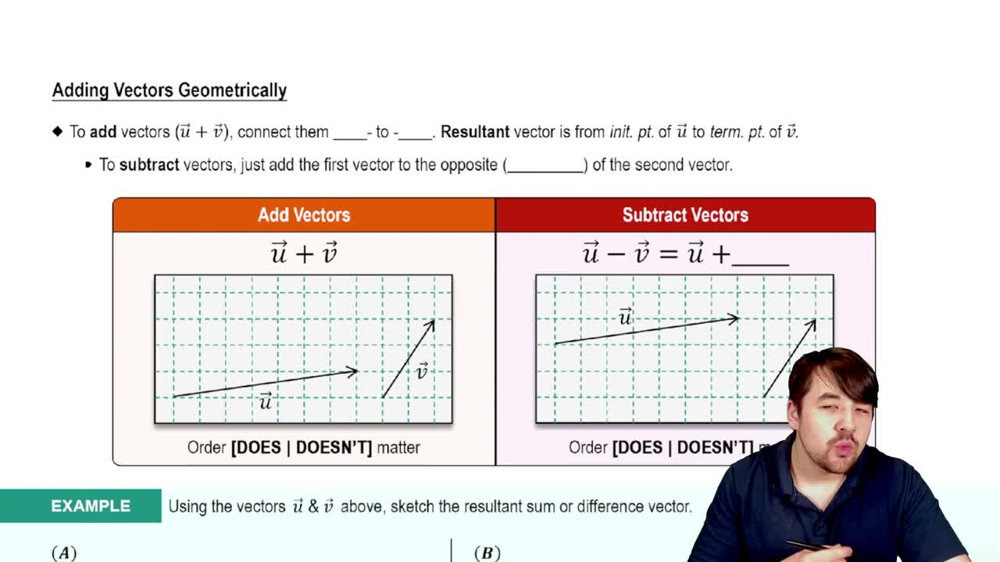
 05:29
05:29