In Exercises 21–26, use a polar coordinate system like the one shown for Exercises 1–10 to plot each point with the given polar coordinates. Then find another representation of this point in which a. r>0, 2π < θ < 4π. b. r<0, 0. < θ < 2π. c. r>0, −2π. < θ < 0. (4, π/2)
Verified step by step guidance
1
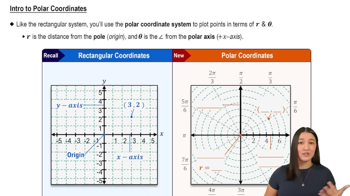
Step 1: Understand the given polar coordinates. The point is given as \((r, \theta) = (4, \frac{\pi}{2})\), where \(r\) is the radius (distance from the origin) and \(\theta\) is the angle measured in radians from the positive x-axis.
Step 2: For part (a), find another representation with \(r > 0\) and \(2\pi < \theta < 4\pi\). Since the angle \(\theta\) can be coterminal by adding multiples of \(2\pi\), add \(2\pi\) to the original angle \(\frac{\pi}{2}\) to get a new angle in the desired range: \(\theta = \frac{\pi}{2} + 2\pi\).
Step 3: For part (b), find another representation with \(r < 0\) and \(0 < \theta < 2\pi\). When \(r\) is negative, the point is in the opposite direction of the angle \(\theta\). To find such a representation, add \(\pi\) to the original angle and change the sign of \(r\): \(r = -4\), \(\theta = \frac{\pi}{2} + \pi\).
Step 4: For part (c), find another representation with \(r > 0\) and \(-2\pi < \theta < 0\). To get an angle in this range, subtract \(2\pi\) from the original angle: \(\theta = \frac{\pi}{2} - 2\pi\) while keeping \(r = 4\).
Step 5: Summarize the new representations found for each part, ensuring the radius and angle satisfy the given conditions, and note that all these points represent the same location in the polar coordinate system.
Verified video answer for a similar problem:
This video solution was recommended by our tutors as helpful for the problem above
Video duration:
2m
Play a video:
0 Comments
Key Concepts
Here are the essential concepts you must grasp in order to answer the question correctly.
Polar Coordinates and Their Representation
Polar coordinates represent points in a plane using a radius (r) and an angle (θ). The radius indicates the distance from the origin, while the angle measures the counterclockwise rotation from the positive x-axis. Understanding how to plot points and interpret these coordinates is fundamental for working with polar systems.
A single point in polar coordinates can have multiple representations by adjusting r and θ. Adding or subtracting multiples of 2π to θ or changing the sign of r while shifting θ by π yields equivalent points. This flexibility allows expressing the same point in different angular intervals or with positive/negative radii.
Angles in polar coordinates can be expressed within various intervals, such as (0, 2π), (2π, 4π), or negative ranges like (−2π, 0). Converting angles to fit these intervals involves adding or subtracting 2π as needed. Mastery of these adjustments is essential for finding alternate representations of points within specified angle bounds.

 2:46 minutes
 Verified step by step guidance
 05:32
05:32