In Exercises 21–26, use a polar coordinate system like the one shown for Exercises 1–10 to plot each point with the given polar coordinates. Then find another representation of this point in which a. r>0, 2π < θ < 4π. b. r<0, 0. < θ < 2π. c. r>0, −2π. < θ < 0. (4, π/2)
Table of contents
- 0. Review of College Algebra4h 45m
- 1. Measuring Angles40m
- 2. Trigonometric Functions on Right Triangles2h 5m
- 3. Unit Circle1h 19m
- 4. Graphing Trigonometric Functions1h 19m
- 5. Inverse Trigonometric Functions and Basic Trigonometric Equations1h 41m
- 6. Trigonometric Identities and More Equations2h 34m
- 7. Non-Right Triangles1h 38m
- 8. Vectors2h 25m
- 9. Polar Equations2h 5m
- 10. Parametric Equations1h 6m
- 11. Graphing Complex Numbers1h 7m
9. Polar Equations
Polar Coordinate System
Problem 29
Textbook Question
In Exercises 27–32, select the representations that do not change the location of the given point. (2, − 3π/4) (2, − 7π/4)
Verified step by step guidance1
Understand that the problem involves identifying different representations of points in polar coordinates that correspond to the same location. The point is given in the form \((r, \theta)\), where \(r\) is the radius (distance from the origin) and \(\theta\) is the angle measured in radians.
Recall that in polar coordinates, the same point can be represented by adding or subtracting full rotations of \(2\pi\) to the angle \(\theta\). This means that \(\theta\) and \(\theta + 2k\pi\) (where \(k\) is any integer) represent the same direction.
Also remember that changing the sign of \(r\) and adding \(\pi\) to the angle gives the same point: \((r, \theta)\) is equivalent to \((-r, \theta + \pi)\). This is because moving in the opposite direction by \(\pi\) radians with a negative radius points to the same location.
For the point \((2, -\frac{3\pi}{4})\), check if the alternative representations add or subtract multiples of \(2\pi\) to the angle or use the negative radius rule to see if the location remains unchanged.
Similarly, for the point \((2, -\frac{7\pi}{4})\), apply the same checks: add or subtract \(2\pi\) multiples to the angle or use the negative radius and angle shift to find equivalent points that do not change the location.
Verified video answer for a similar problem:This video solution was recommended by our tutors as helpful for the problem above
Play a video:
0 Comments
Key Concepts
Here are the essential concepts you must grasp in order to answer the question correctly.
Polar Coordinates and Point Representation
Polar coordinates represent points using a radius and an angle, written as (r, θ). The radius r is the distance from the origin, and θ is the angle measured from the positive x-axis. Understanding how points are plotted in this system is essential to analyze changes in location.
Recommended video:
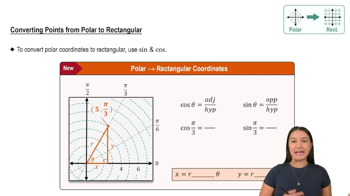
Convert Points from Polar to Rectangular
Angle Coterminality in Polar Coordinates
Angles that differ by multiples of 2π radians are coterminal, meaning they point in the same direction on the polar plane. Recognizing coterminal angles helps identify when different angle measures represent the same point location.
Recommended video:
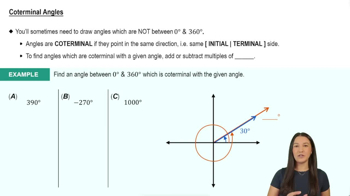
Coterminal Angles
Effect of Negative Radius and Angle Adjustments
In polar coordinates, a negative radius reverses the direction of the point by π radians, effectively changing its location unless the angle is adjusted accordingly. Understanding how changing the sign of r or modifying θ affects the point's position is crucial for determining if the location remains unchanged.
Recommended video:
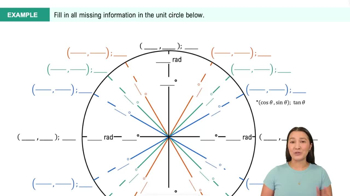
Example 2
Related Videos
Related Practice
Textbook Question
834
views
