 Back
BackChapter 1: Trigonometric Functions – Angles, Triangles, and Trigonometric Definitions
Study Guide - Smart Notes
 Tailored notes based on your materials, expanded with key definitions, examples, and context.
Chapter 1: Trigonometric Functions
Section 1.1: Angles
Angles are fundamental in trigonometry, measured in degrees (°) or radians. Key relationships include complementary and supplementary angles, as well as coterminal angles.
Complementary Angles: Two angles whose measures add up to 90°.
Supplementary Angles: Two angles whose measures add up to 180°.
Coterminal Angles: Angles that share the same terminal side when drawn in standard position. To find a coterminal angle, add or subtract multiples of 360°.
Example: The complement of 55° is 35° (90° – 55°). The supplement of 55° is 125° (180° – 55°).
Example: 1106° is coterminal with 26° (1106° – 3 × 360° = 26°).
Section 1.2: Angle Relationships and Similar Triangles
Angles can be related through geometric configurations, such as vertical angles, alternate exterior angles, and through similarity of triangles. Similar triangles have equal corresponding angles and proportional corresponding sides.
Vertical Angles: Angles opposite each other when two lines cross; they are always equal.
Alternate Exterior Angles: Angles on opposite sides of a transversal but outside the two lines; they are equal if the lines are parallel.
Similar Triangles: Triangles with the same shape but not necessarily the same size. Corresponding sides are proportional, and corresponding angles are equal.
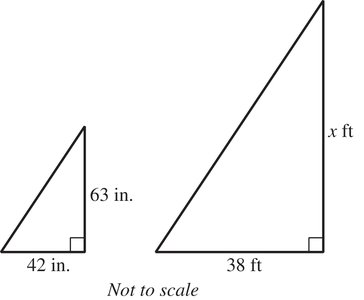
Example: If triangles are similar and one triangle has sides 42 in. and 63 in., and the other has a corresponding side of 38 ft, the unknown side x can be found by setting up a proportion:
Solving for x gives ft.
Section 1.3: Trigonometric Functions
Trigonometric functions relate the angles of a right triangle to the ratios of its sides. For a point (x, y) on the terminal side of an angle θ in standard position, with distance r from the origin, the six trigonometric functions are defined as:
Sine:
Cosine:
Tangent:
Cosecant:
Secant:
Cotangent:
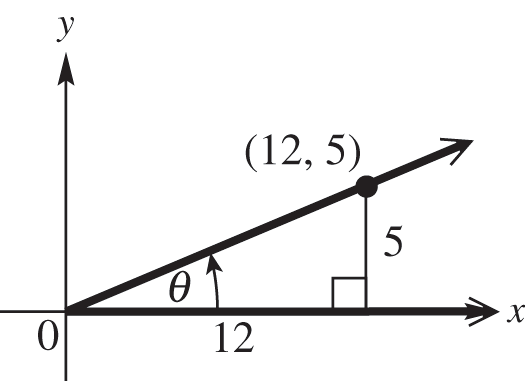
Example: For the point (12, 5):
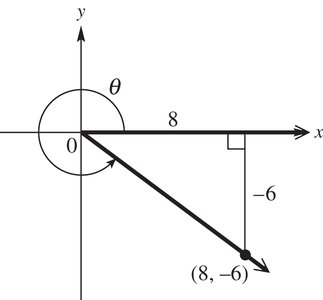
Example: For the point (8, –6):
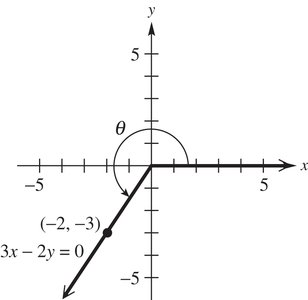
Example: For a line passing through (–2, –3):
Section 1.4: Using the Definitions of the Trigonometric Functions
Special cases occur when the terminal side of an angle lies on the x- or y-axis.
For (5, 0):
is undefined
is undefined
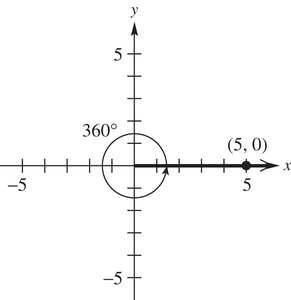
For (0, –5):
is undefined
is undefined
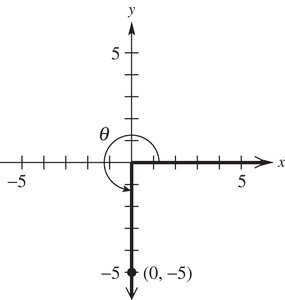
Reciprocal and Range Properties
Each trigonometric function has a reciprocal:
and
and
and
The range of each function is important for determining possible values:
: [–1, 1]
: (–∞, ∞)
: (–∞, –1] ∪ [1, ∞)
Example: is impossible because cosine values must be between –1 and 1.
Quadrants and Signs of Trigonometric Functions
The sign of a trigonometric function depends on the quadrant in which the terminal side of the angle lies:
Quadrant I: All functions positive
Quadrant II: Sine and cosecant positive
Quadrant III: Tangent and cotangent positive
Quadrant IV: Cosine and secant positive
Example: For θ in quadrant III, and .
Solving for Trigonometric Functions Given One Value
If one trigonometric function value is known, the others can be found using Pythagorean identities and quadrant information.
Pythagorean Identity:
Example: If and , then
Use the sign information from the quadrant to determine the correct sign for each function.
Additional info: These notes cover the foundational concepts of trigonometric functions, angle relationships, and the use of triangles in trigonometry, as outlined in a typical college-level trigonometry course.
