 Back
BackFoundations of Geometry and Measurement for Trigonometry
Study Guide - Smart Notes
 Tailored notes based on your materials, expanded with key definitions, examples, and context.
Review of College Algebra and Geometry
Square Roots and Properties
Understanding square roots and their properties is essential for solving equations and working with geometric figures in trigonometry.
Square Root Definition: For a positive number x, is the positive number whose square is x.
Undefined for Negatives: is not defined for x < 0 in the set of real numbers.
Examples: , ,
Product Rule: for
Quotient Rule: for
Parallel Lines: Lines in the same plane that never intersect. Perpendicular Lines: Lines that intersect at a right angle (90°).
Angle: Formed by two rays with a common endpoint.
Similar and Congruent Shapes
Understanding similarity and congruence is foundational for trigonometry, especially when working with triangles.
Similar Shapes: Same shape, corresponding angles are equal, and sides are proportional.
Congruent Shapes: Same shape and size; corresponding sides and angles are equal.
Proof: A logical argument that uses deductive reasoning to show a statement is true.
Measuring Angles and Circles
Area and Circumference of Circles
Circles are fundamental in trigonometry, especially for defining angles and trigonometric functions.
Area of a Circle: , where r is the radius.
Circumference of a Circle:
Diameter:
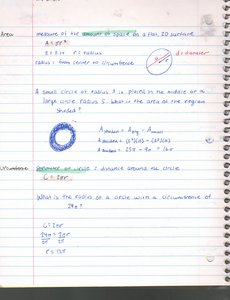
Example: If the circumference of a circle is , then .
Sectors and Arcs
A sector is a region of a circle bounded by two radii and the arc between them. The arc is a portion of the circle's circumference.
Area of a Sector: , where is the central angle in degrees.
Arc Length:
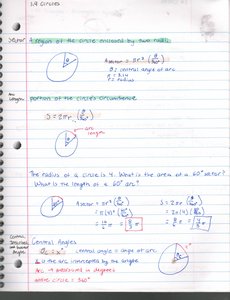
Example: For a circle of radius 4 and a central angle of 60°, the area of the sector is , and the arc length is .
Central and Inscribed Angles
Angles in circles are classified based on their vertex location.
Central Angle: Vertex at the center of the circle; its measure equals the intercepted arc.
Inscribed Angle: Vertex on the circle; its measure is half the intercepted arc.
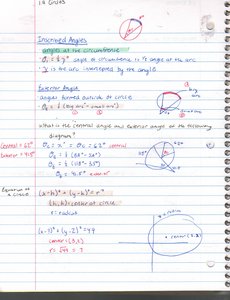
Example: If an inscribed angle intercepts an arc of 80°, the angle measures 40°.
Triangles and Polygons
Triangles: Types, Area, and Perimeter
Triangles are the basis for trigonometric ratios and identities.
Area of a Triangle:
Perimeter: Sum of all side lengths.
Equilateral Triangle: All sides and angles are equal.
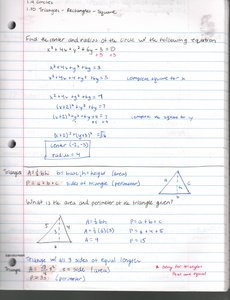
Example: For a triangle with sides 3, 4, and 5, and perimeter .
Rectangles and Squares
Rectangles and squares are special quadrilaterals with right angles, often used in geometric proofs and area calculations.
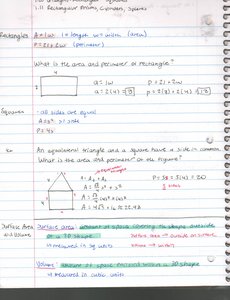
Area of a Rectangle:
Perimeter of a Rectangle:
Area of a Square:
Perimeter of a Square:
Surface Area and Volume of Solids
Prisms, Cylinders, and Spheres
Understanding three-dimensional shapes is important for applications of trigonometry in geometry and physics.
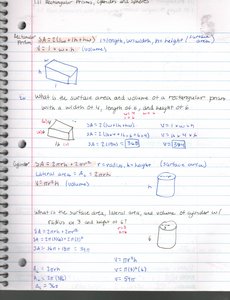
Rectangular Prism:
Surface Area:
Volume:
Cylinder:
Surface Area:
Lateral Area:
Volume:
Sphere:
Surface Area:
Volume:
Right Triangles and the Pythagorean Theorem
Pythagorean Theorem
The Pythagorean Theorem is a fundamental result relating the sides of a right triangle, forming the basis for trigonometric ratios.
Theorem Statement: In a right triangle with legs a and b, and hypotenuse c:
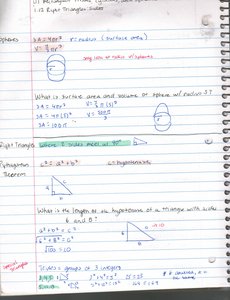
Example: If and , then .
Additional info:
Some content, such as basic area and volume formulas, is foundational for trigonometry but may also be covered in geometry courses. These notes provide a comprehensive review relevant for students beginning a college trigonometry course.
