 Back
BackRight Triangles and Trigonometry Study Guide – Key Concepts and Problem-Solving Steps
Study Guide - Smart Notes
 Tailored notes based on your materials, expanded with key definitions, examples, and context.
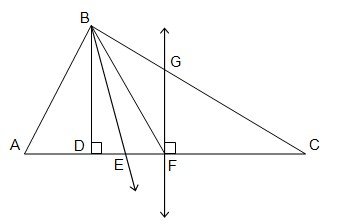
Q3. Name the following in the triangle diagram: Median, Altitude, Angle Bisector, Perpendicular Bisector
Background
Topic: Triangle Centers and Special Segments
This question tests your understanding of the definitions and geometric properties of special lines and segments in triangles: medians, altitudes, angle bisectors, and perpendicular bisectors. You are asked to identify these in a given triangle diagram.
Key Terms and Definitions:
Median: A segment from a vertex to the midpoint of the opposite side.
Altitude: A perpendicular segment from a vertex to the line containing the opposite side.
Angle Bisector: A segment that divides an angle of the triangle into two equal angles.
Perpendicular Bisector: A line that is perpendicular to a side of the triangle and passes through its midpoint.
Step-by-Step Guidance
Examine each segment in the diagram and match it to the definitions above. Look for right angles (indicating perpendicularity), midpoints, and segments that split angles in half.
Identify the median: Find the segment that connects a vertex to the midpoint of the opposite side. In the diagram, check which segment starts at a vertex and ends at the midpoint of the opposite side.
Identify the altitude: Look for a segment that starts at a vertex and meets the opposite side (or its extension) at a right angle (indicated by a small square).
Identify the angle bisector: Find the segment that splits one of the triangle's angles into two equal parts. This segment will start at a vertex and pass through the interior of the triangle, dividing the angle into two congruent angles.
Identify the perpendicular bisector: Look for a line or segment that is perpendicular to a side and passes through its midpoint. This does not necessarily start at a vertex.
Try solving on your own before revealing the answer!
