 Back
BackTrigonometry Exam 3 Study Guide Solutions
Study Guide - Smart Notes
 Tailored notes based on your materials, expanded with key definitions, examples, and context.
Graphs of Trigonometric Functions
Graphing Sine and Cosine Functions
Understanding the graphs of sine and cosine functions is fundamental in trigonometry. These periodic functions are characterized by their amplitude, period, phase shift, and vertical shift.
Amplitude: The maximum distance from the midline to the peak (for y = a sin(x), amplitude is |a|).
Period: The length of one complete cycle. For y = sin(bx), period is .
Phase Shift: Horizontal shift left or right.
Vertical Shift: Up or down movement of the graph.
Example: For , the amplitude is 2, period is , and there is no phase or vertical shift.
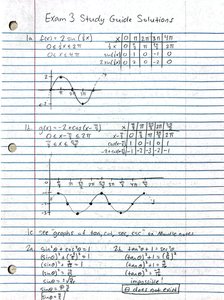
Example: For , the amplitude is 2, period is , and the graph is reflected over the x-axis.
Evaluating Trigonometric Functions
Exact Values of Sine, Cosine, and Tangent
Trigonometric functions have well-known values at special angles (0, , , , , etc.). These values are essential for solving equations and simplifying expressions.
sin(0) = 0
sin() =
sin() =
sin() =
sin() = 1
Similar values exist for cosine and tangent. These can be organized in a table for quick reference.
Trigonometric Identities
Fundamental Identities
Trigonometric identities are equations involving trigonometric functions that are true for all values of the variable where both sides are defined. They are used to simplify expressions and solve equations.
Pythagorean Identity:
Quotient Identities: ,
Reciprocal Identities: , ,
Sum and Difference Formulas
These formulas allow the calculation of trigonometric functions of sums or differences of angles.
Example:
Double Angle and Half Angle Formulas
These identities are useful for expressing trigonometric functions of double or half angles in terms of single angles.
Solving Trigonometric Equations
General Strategies
To solve trigonometric equations, use identities to simplify the equation, isolate the trigonometric function, and solve for the variable within the given interval.
Use algebraic manipulation and identities to simplify.
Consider all possible solutions within the specified domain (often ).
Check for extraneous solutions, especially when squaring both sides.
Reference Angles and Quadrants
Determining Signs of Trigonometric Functions
The sign of a trigonometric function depends on the quadrant in which the terminal side of the angle lies.
Quadrant I: All functions positive
Quadrant II: Sine positive
Quadrant III: Tangent positive
Quadrant IV: Cosine positive
Example: If and , then is in Quadrant IV.
Table: Exact Values of Trigonometric Functions at Special Angles
Angle (degrees) | Angle (radians) | sin | cos | tan |
|---|---|---|---|---|
0° | 0 | 0 | 1 | 0 |
30° | ||||
45° | 1 | |||
60° | ||||
90° | 1 | 0 | undefined |
Additional info: Table values inferred from standard trigonometric tables for completeness.
