 Back
BackTrigonometry Study Guide: Angles, Trigonometric Functions, and Graphs
Study Guide - Smart Notes
 Tailored notes based on your materials, expanded with key definitions, examples, and context.
Angles and Their Properties
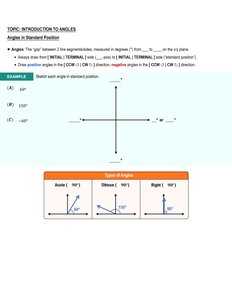
Angles in Standard Position
Angles are measured from the positive x-axis, with their vertex at the origin. The initial side lies along the x-axis, and the terminal side is rotated to form the angle. Angles can be positive (counterclockwise rotation) or negative (clockwise rotation).
Acute Angle: Less than 90°
Obtuse Angle: Greater than 90° but less than 180°
Right Angle: Exactly 90°
Complementary and Supplementary Angles
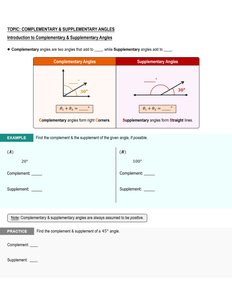
Complementary angles add up to 90°, while supplementary angles add up to 180°. These relationships are fundamental in solving problems involving right triangles and linear pairs.
Complementary Angles:
Supplementary Angles:
Solving Problems with Complementary & Supplementary Angles
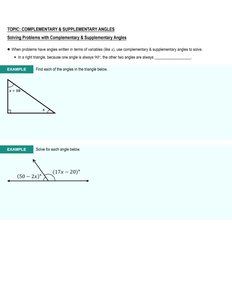
When angles are written in terms of variables, use the relationships above to solve for unknowns. In a right triangle, the two non-right angles are always complementary.
Radians and Degree Conversion
Converting Between Degrees and Radians
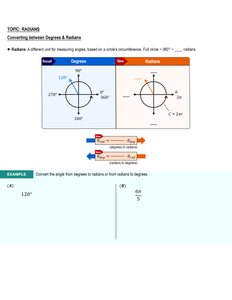
Radians are another unit for measuring angles, based on the arc length of a circle. The conversion between degrees and radians is essential for trigonometric calculations.
Conversion Formula:
Full circle: radians
Right Triangle Trigonometry
Introduction to Trigonometric Functions
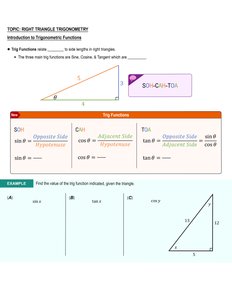
Trigonometric functions relate the angles of a right triangle to the ratios of its sides. The three main functions are sine, cosine, and tangent.
Sine:
Cosine:
Tangent:
Reciprocal Trigonometric Functions
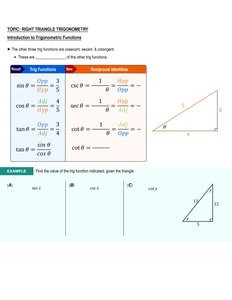
There are three reciprocal trigonometric functions: cosecant, secant, and cotangent. These are defined as follows:
Cosecant:
Secant:
Cotangent:
Inverse Trigonometric Functions
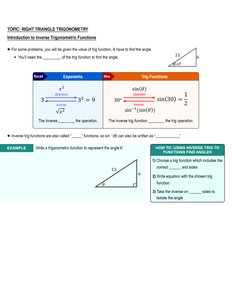
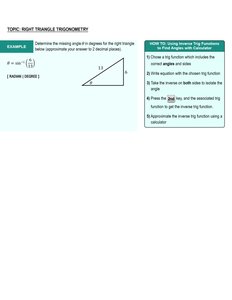
Inverse trigonometric functions are used to find angles when the value of a trigonometric function is known. For example, , , and .
Example:
Using a Calculator for Trig Functions
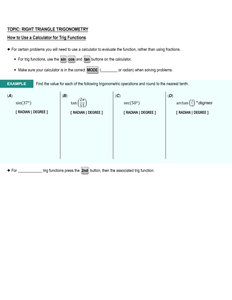
To evaluate trigonometric functions, use the appropriate calculator mode (DEG or RAD) and function buttons. For inverse functions, use the 2nd button.
Solving Right Triangles
Finding Missing Side Lengths
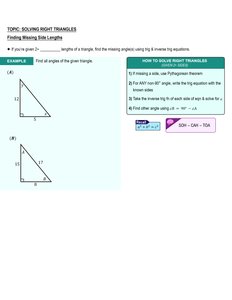
To find missing side lengths in a right triangle, use trigonometric ratios and the Pythagorean Theorem.
Pythagorean Theorem:
Trig Equations: Use SOH-CAH-TOA to relate sides and angles.
Finding Missing Angles
If two side lengths are given, use inverse trig functions to find the missing angle.
Special Right Triangles
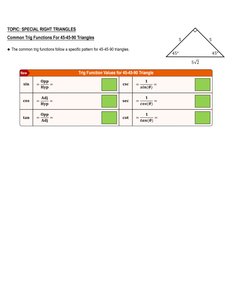
45-45-90 Triangles
In a 45-45-90 triangle, the legs are equal and the hypotenuse is times the length of a leg. Trig functions for these triangles follow specific patterns.
Function | Value |
|---|---|
sin 45° | |
cos 45° | |
tan 45° | 1 |
csc 45° | |
sec 45° | |
cot 45° | 1 |
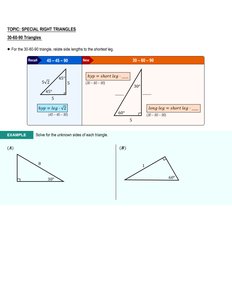
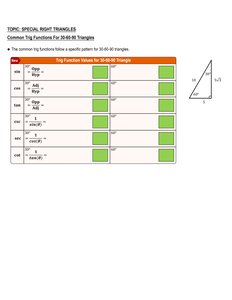
30-60-90 Triangles
In a 30-60-90 triangle, the sides are in the ratio 1 : : 2. Trig functions for these triangles also follow specific patterns.
Function | Value |
|---|---|
sin 30° | |
cos 30° | |
tan 30° | |
csc 30° | 2 |
sec 30° | |
cot 30° |
Graphs of Trigonometric Functions
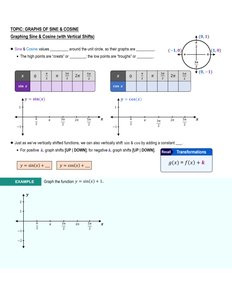
Graphing Sine and Cosine (with Vertical Shift)
Sine and cosine functions are periodic and can be shifted vertically. The high points are called "crests" and the low points "troughs." The general form is .
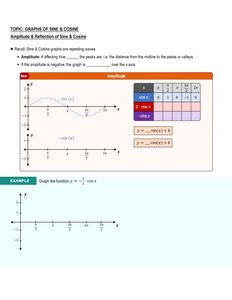
Amplitude and Reflection of Sine & Cosine
Amplitude is the distance from the midline to the peak or valley. If the amplitude is negative, the graph is reflected.
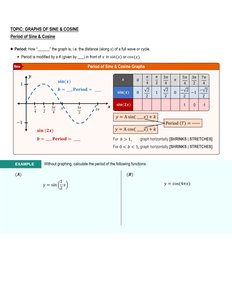
Period of Sine & Cosine
The period is the length of one full cycle. For or , the period is .
Graphs of Secant & Cosecant
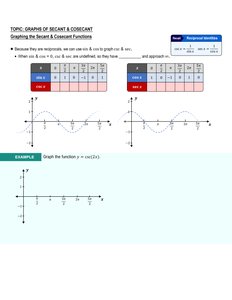
Secant and cosecant functions are reciprocals of cosine and sine, respectively. Their graphs have vertical asymptotes where the original function is zero.
Graphs of Tangent & Cotangent
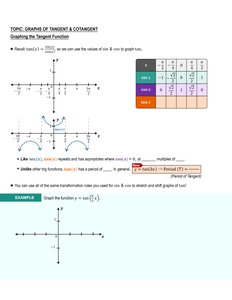
Tangent and cotangent functions have repeating cycles and vertical asymptotes. The period of tangent is , and cotangent is also $\pi$.
Co-functions of Complementary Angles
Co-function Identities
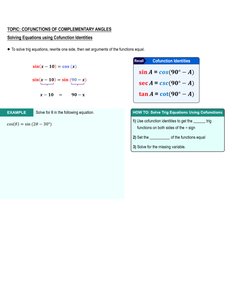
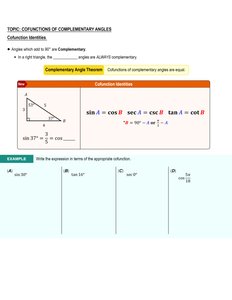
Co-function identities relate trigonometric functions of complementary angles. For example, .
Solving Equations Using Co-function Identities
To solve equations, rewrite one side using co-function identities, then set arguments equal and solve for the variable.
Summary Table: Trigonometric Functions and Their Properties
Function | Definition | Reciprocal |
|---|---|---|
sin | csc | |
cos | sec | |
tan | cot | |
csc | sin | |
sec | cos | |
cot | tan |
Additional info: This study guide covers foundational trigonometry topics relevant to college-level courses, including angle measurement, trigonometric functions, special triangles, and graphing. All images included directly reinforce the explanations and are essential for visual understanding.
