
(Modeling) Fish's View of the World The figure shows a fish's view of the world above the surface of the water. (Data from Walker, J., 'The Amateur Scientist,' Scientific American.) Suppose that a light ray comes from the horizon, enters the water, and strikes the fish's eye. Assume that this ray gives a value of 90° for angle θ₁ in the formula for Snell's law. (In a practical situation, this angle would probably be a little less than 90°.) The speed of light in water is about 2.254 x 10⁸ m per sec. Find angle θ₂ to the nearest tenth.
Find a value of θ in the interval [0°, 90°) that satisfies each statement. Give answers in decimal degrees to six decimal places. See Example 2.
cos θ = 0.85536428
Verified step by step guidance
Verified video answer for a similar problem:
Key Concepts
Cosine Function and Its Properties
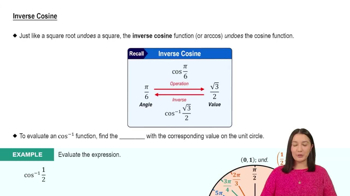
Inverse Cosine (Arccos) Function
Decimal Degree Precision
CONCEPT PREVIEW Match each trigonometric function value or angle in Column I with its appropriate approximation in Column II.
Column I: 1.
cot⁻¹ 30
Column II:
A. 88.09084757°
B. 63.25631605°
C. 1.909152433°
D. 17.45760312°
E. 0.2867453858
F. 1.962610506
G. 14.47751219°
H. 1.015426612
I. 1.051462224
J. 0.9925461516
Determine whether each statement is true or false. If false, tell why. Use a calculator for Exercises 39 and 42. 1 tan² 60° = sec² 60°
Solve each problem. See Examples 3 and 4. Height of an Antenna A scanner antenna is on top of the center of a house. The angle of elevation from a point 28.0 m from the center of the house to the top of the antenna is 27°10', and the angle of elevation to the bottom of the antenna is 18°10'. Find the height of the antenna.
Find two angles in the interval [0°, 360°) that satisfy each of the following. Round answers to the nearest degree. cos θ = 0.10452846
Use a calculator to approximate the value of each expression. Give answers to six decimal places. tan 11.7689°
