Ch. 2 - Acute Angles and Right Triangles
Lial - Trigonometry 12th Edition
Lial12th EditionTrigonometryISBN: 9780136552161Not the one you use?Change textbook
Chapter 3, Problem 2.R.29

Use a calculator to approximate the value of each expression. Give answers to six decimal places. tan 11.7689°

Verified step by step guidance
1
Recognize that the problem asks for the value of \(\tan 11.7689^\circ\), which means we need to find the tangent of the angle 11.7689 degrees.
Ensure your calculator is set to degree mode since the angle is given in degrees, not radians.
Input the angle 11.7689 into the calculator and then use the tangent function to find \(\tan(11.7689^\circ)\).
Calculate the value and then round or truncate the result to six decimal places as requested.
Write down the final answer with six decimal places, ensuring accuracy and proper formatting.

Verified video answer for a similar problem:

This video solution was recommended by our tutors as helpful for the problem above.
Video duration:
1m
Was this helpful?

Key Concepts

Here are the essential concepts you must grasp in order to answer the question correctly.

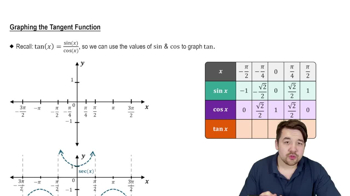
Understanding the Tangent Function

The tangent function relates an angle in a right triangle to the ratio of the opposite side over the adjacent side. It is defined for all angles except where cosine is zero, and its values can be positive or negative depending on the angle's quadrant.
Recommended video:
5:43
Introduction to Tangent Graph

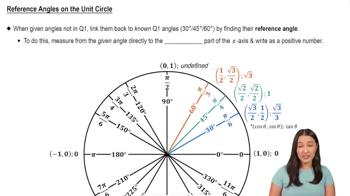
Degree Measure and Angle Conversion

Angles can be measured in degrees or radians. In this problem, the angle is given in degrees, so it is important to ensure the calculator is set to degree mode to get the correct tangent value.
Recommended video:
5:31
Reference Angles on the Unit Circle

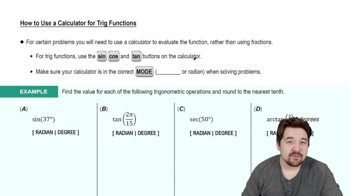
Using a Calculator for Trigonometric Approximations

Calculators can compute trigonometric functions to high precision. To approximate tan(11.7689°), input the angle in degree mode and round the result to six decimal places as required for accuracy.
Recommended video:
4:45
How to Use a Calculator for Trig Functions
Related Practice
Textbook Question

Find a value of θ in the interval [0°, 90°) that satisfies each statement. Give answers in decimal degrees to six decimal places. See Example 2.

cos θ = 0.85536428

615
views

Textbook Question

(Modeling) Fish's View of the World The figure shows a fish's view of the world above the surface of the water. (Data from Walker, J., 'The Amateur Scientist,' Scientific American.) Suppose that a light ray comes from the horizon, enters the water, and strikes the fish's eye. Assume that this ray gives a value of 90° for angle θ₁ in the formula for Snell's law. (In a practical situation, this angle would probably be a little less than 90°.) The speed of light in water is about 2.254 x 10⁸ m per sec. Find angle θ₂ to the nearest tenth.

606
views
Textbook Question

Use a calculator to approximate the value of each expression. Give answers to six decimal places. sec 222° 30'

591
views
Textbook Question

Find two angles in the interval [0°, 360°) that satisfy each of the following. Round answers to the nearest degree. tan θ = 1.3763819

645
views
Textbook Question

Determine whether each statement is true or false. If false, tell why. Use a calculator for Exercises 39 and 42. 1 tan² 60° = sec² 60°

659
views
Textbook Question

Solve each problem. See Examples 3 and 4. Height of an Antenna A scanner antenna is on top of the center of a house. The angle of elevation from a point 28.0 m from the center of the house to the top of the antenna is 27°10', and the angle of elevation to the bottom of the antenna is 18°10'. Find the height of the antenna.

861
views