What is the importance of acetylcholinesterase in muscle cell contraction?
Verified step by step guidance
1
Understand that acetylcholinesterase is an enzyme located in the synaptic cleft between the motor neuron and the muscle cell membrane (sarcolemma).
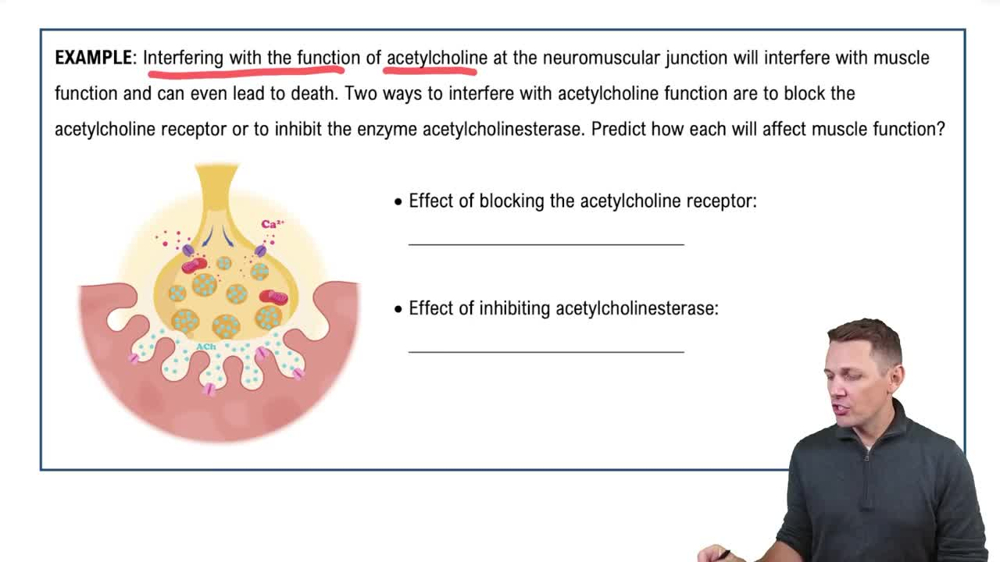
Recognize that acetylcholinesterase's primary role is to break down the neurotransmitter acetylcholine (ACh) after it has transmitted the nerve impulse to the muscle cell.
Know that by breaking down acetylcholine, acetylcholinesterase stops the continuous stimulation of the muscle cell, which is essential for muscle relaxation.
Realize that without acetylcholinesterase, acetylcholine would remain in the synaptic cleft, causing prolonged muscle contraction or muscle fatigue.
Conclude that acetylcholinesterase is crucial for regulating the timing of muscle contraction and relaxation, allowing muscles to contract only when needed and then relax properly.
Verified video answer for a similar problem:
This video solution was recommended by our tutors as helpful for the problem above
Video duration:
2m
Play a video:
0 Comments
Key Concepts
Here are the essential concepts you must grasp in order to answer the question correctly.
Role of Acetylcholine in Muscle Contraction
Acetylcholine is a neurotransmitter released at the neuromuscular junction that binds to receptors on muscle cells, triggering an electrical signal that initiates muscle contraction. Its presence is essential for transmitting the nerve impulse to the muscle fiber.
Acetylcholinesterase is an enzyme that breaks down acetylcholine in the synaptic cleft, terminating the signal between the nerve and muscle. This breakdown prevents continuous stimulation, allowing the muscle to relax after contraction.
Proper muscle function depends on the balance between acetylcholine release and its breakdown by acetylcholinesterase. Without acetylcholinesterase, acetylcholine would accumulate, causing prolonged contraction or muscle fatigue, highlighting its importance in muscle control.