The ions that enter the skeletal muscle cell during the generation of an action potential are a. Calcium ions b. Chloride ions c. Sodium ions d. Potassium ions
Verified step by step guidance
1
Understand the process of action potential generation in skeletal muscle cells, which involves changes in membrane permeability to specific ions.
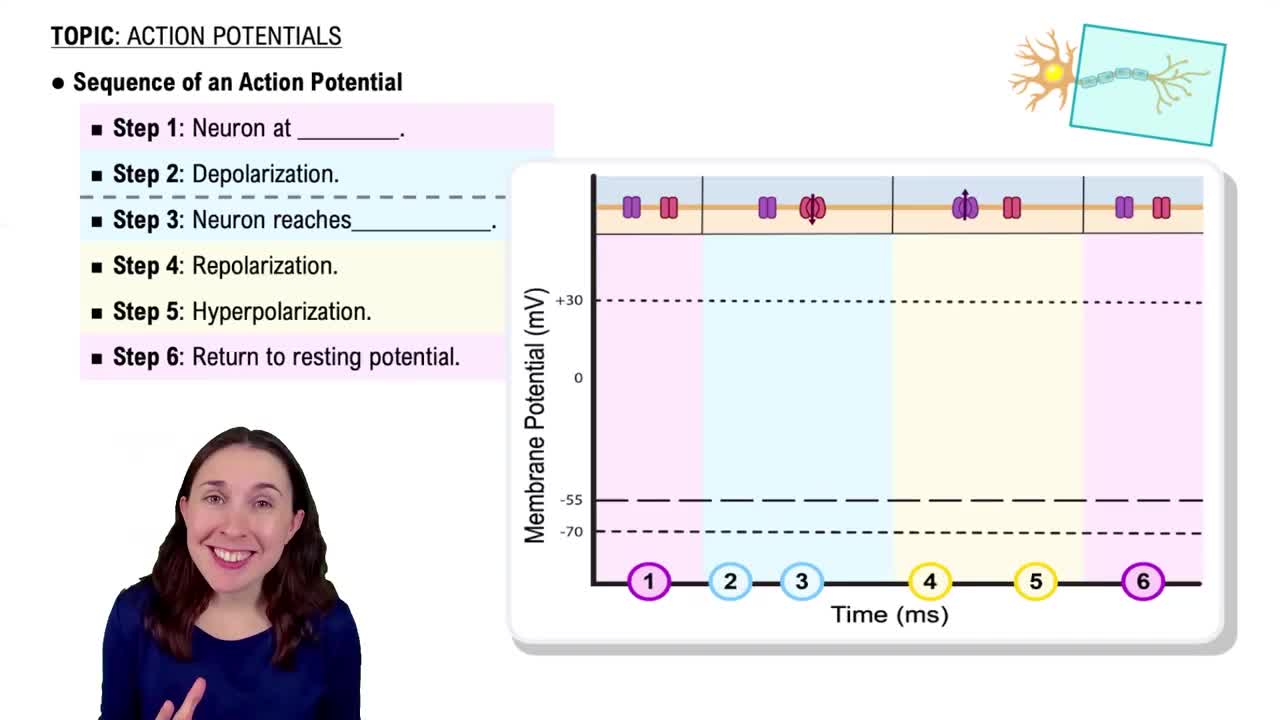
Recall that during the depolarization phase of the action potential, the membrane becomes permeable to sodium ions, allowing them to enter the cell.
Recognize that calcium ions play a role in muscle contraction but do not primarily enter the cell during the initial action potential generation.
Note that chloride ions generally help stabilize the resting membrane potential and do not enter the cell during the action potential.
Remember that potassium ions exit the cell during repolarization, not enter during the generation of the action potential.
Verified video answer for a similar problem:
This video solution was recommended by our tutors as helpful for the problem above
Video duration:
3m
Play a video:
0 Comments
Key Concepts
Here are the essential concepts you must grasp in order to answer the question correctly.
Action Potential in Skeletal Muscle
An action potential in skeletal muscle is a rapid change in membrane potential that triggers muscle contraction. It involves the movement of ions across the muscle cell membrane, leading to depolarization and repolarization phases essential for signal transmission.
During the initiation of an action potential, sodium channels open, allowing Na⁺ ions to enter the muscle cell. This influx causes the membrane potential to become more positive, leading to depolarization, which is the key step in generating the action potential.
After depolarization, potassium channels open to allow K⁺ ions to exit the cell, restoring the negative resting membrane potential. This efflux of K⁺ ions is crucial for repolarization, helping the muscle cell return to its resting state after an action potential.