 Back
BackExam 3 Study Guide: Muscular and Nervous System Concepts
Study Guide - Smart Notes
 Tailored notes based on your materials, expanded with key definitions, examples, and context.
Q1. Classification of Muscles: Based on Actions and Shapes
Background
Topic: Muscle Classification
This question tests your understanding of how muscles are categorized by their actions (such as flexion, extension, abduction) and by their shapes (such as fusiform, parallel, pennate, circular).
Key Terms:
Action: The movement a muscle produces (e.g., flexor, extensor).
Shape: The physical form of the muscle (e.g., deltoid = triangular, biceps = fusiform).
Step-by-Step Guidance
Identify the main actions muscles can perform (flexion, extension, rotation, etc.).
List common muscle shapes and match examples (e.g., deltoid = triangular, orbicularis = circular).
Review diagrams of skeletal muscle anatomy to see how structure relates to function.
Try solving on your own before revealing the answer!
Q2. Muscles: Location in the Body and Functions
Background
Topic: Major Muscles and Their Functions
This question asks you to identify the location and function of key muscles such as the deltoid, biceps, pectoralis, and others.
Key Terms:
Origin and Insertion: Where the muscle attaches to bone.
Function: The movement the muscle produces.
Step-by-Step Guidance
Review anatomical diagrams (Lab manual p.192-193) to locate each muscle.
For each muscle, note its primary function (e.g., biceps brachii = forearm flexion).
Group muscles by region (e.g., upper limb, lower limb, trunk).
Try solving on your own before revealing the answer!
Q3. Muscle Lever System
Background
Topic: Biomechanics of Muscle Action
This question tests your understanding of how muscles act as levers to produce movement.
Key Terms and Formulas:
Lever: A rigid structure (bone) that moves on a fulcrum (joint).
Effort, Load, Fulcrum: Components of a lever system.
Step-by-Step Guidance
Identify the three classes of levers (first, second, third) and their arrangement in the body.
Match muscle actions to lever types (e.g., biceps = third-class lever).
Draw or review diagrams showing lever systems in muscle movement.
Try solving on your own before revealing the answer!
Q4. Sarcomere Microscopic Structure
Background
Topic: Muscle Fiber Anatomy
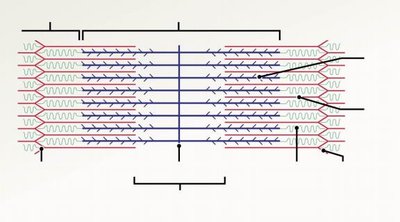
This question tests your knowledge of the sarcomere, the basic contractile unit of muscle.
Key Terms:
Sarcomere: The segment between two Z lines.
Actin, Myosin: The main contractile proteins.
A band, I band, H zone, Z line, M line: Structural features of the sarcomere.
Step-by-Step Guidance
Identify the boundaries of a sarcomere (Z lines).
Locate the A band (myosin), I band (actin), H zone (center of A band), and M line (middle of sarcomere).
Review diagrams to visualize the arrangement of actin and myosin filaments.
Try solving on your own before revealing the answer!
Q5. Sliding Filament Theory
Background
Topic: Muscle Contraction Mechanism
This question tests your understanding of how actin and myosin interact to produce muscle contraction.
Key Terms and Formulas:
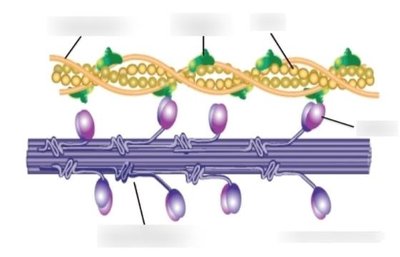
Actin, Myosin: Contractile proteins.
ATP: Energy source for contraction.
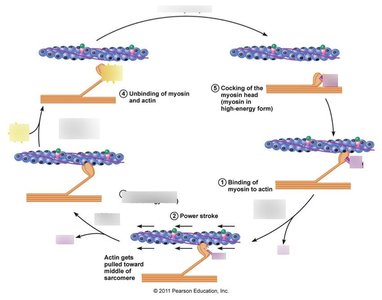
Cross-bridge cycle: Sequence of events in contraction.
Step-by-Step Guidance
Describe the role of ATP in energizing the myosin head.
Explain how myosin binds to actin to form a cross-bridge.
Outline the power stroke and release of ADP and Pi.
Discuss the detachment of myosin from actin and resetting of the cycle.
Try solving on your own before revealing the answer!
Q6. Sequence of Muscle Contraction Events
Background
Topic: Steps in Muscle Contraction
This question tests your ability to describe the sequence of events from nerve impulse to muscle contraction.
Key Terms:
Neuromuscular junction: Site where nerve meets muscle.
Acetylcholine: Neurotransmitter involved.
Calcium ions: Trigger contraction.
Step-by-Step Guidance
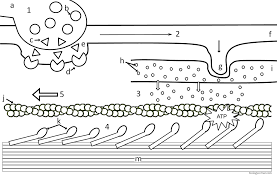
Describe the arrival of the nerve impulse at the neuromuscular junction.
Explain the release of acetylcholine and its effect on the muscle membrane.
Discuss the influx of calcium ions and their role in exposing binding sites on actin.
Outline the steps leading to cross-bridge formation and contraction.
Try solving on your own before revealing the answer!
Q7. Isometric and Isotonic Muscle Contractions
Background
Topic: Types of Muscle Contraction
This question tests your understanding of the difference between isometric (no change in length) and isotonic (change in length) contractions.
Key Terms:
Isometric: Muscle contracts but does not change length.
Isotonic: Muscle contracts and changes length (concentric or eccentric).
Step-by-Step Guidance
Define isometric and isotonic contractions.
Give examples of each type (e.g., holding a weight vs. lifting a weight).
Explain the physiological significance of each contraction type.
Try solving on your own before revealing the answer!
Q8. Nervous System: General Structure and Functions
Background
Topic: Nervous System Anatomy and Physiology
This question tests your knowledge of the structure and function of the nervous system, including synapses, neuron polarization, and neurotransmitters.
Key Terms:
Neuron: Basic cell of the nervous system.
Synapse: Junction between neurons.
Polarization, depolarization, repolarization, hyperpolarization: Electrical states of neurons.
Neurotransmitter: Chemical messenger.
Step-by-Step Guidance
Describe the main parts of a neuron (cell body, axon, dendrites).
Explain the process of synaptic transmission.
Discuss the changes in membrane potential during polarization, depolarization, and repolarization.
List major neurotransmitters and their functions.
Try solving on your own before revealing the answer!
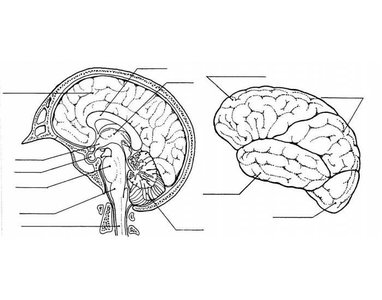
Q9. Brain Anatomy and Functions
Background
Topic: Brain Structure and Function
This question tests your knowledge of the anatomy of the brain, including the cerebral cortex, brain stem, hypothalamus, and other regions.
Key Terms:
Cerebral cortex: Higher-order processing.
Brain stem: Basic life functions.
Hypothalamus: Homeostasis regulation.
Meninges: Protective layers.
CSF: Cerebrospinal fluid.
Step-by-Step Guidance
Identify major brain regions and their functions.
Describe the layers of the meninges and their protective roles.
Locate the ventricles and CSF spaces in the brain.
Explain the difference between gray matter and white matter.
Try solving on your own before revealing the answer!
