 Back
BackMetabolism and Energy Balance: Anabolism, Catabolism, and Regulation
Study Guide - Smart Notes
 Tailored notes based on your materials, expanded with key definitions, examples, and context.
Metabolism: Overview and Catabolic Pathways
Introduction to Metabolism
Metabolism encompasses all chemical reactions that occur within living organisms to maintain life. It is divided into two main categories: catabolism (breaking down molecules to release energy) and anabolism (building complex molecules from simpler ones). Catabolic reactions provide the energy required for anabolic processes and other cellular activities.
Catabolism involves the breakdown of carbohydrates, lipids, and proteins to produce ATP, the cell's main energy currency.
Anabolism uses ATP to synthesize complex molecules such as glycogen, triglycerides, and proteins.
Catabolism of Major Nutrients
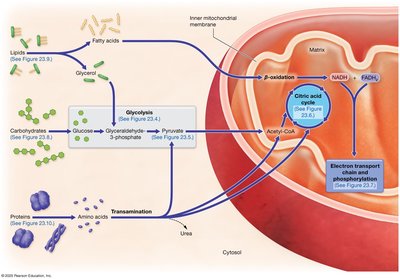
Carbohydrates: Broken down into glucose, which undergoes glycolysis to form pyruvate. Pyruvate can be further metabolized aerobically (with oxygen) in the mitochondria or anaerobically (without oxygen) in the cytosol.
Lipids: Triglycerides are split into glycerol and fatty acids. Glycerol enters glycolysis, while fatty acids undergo beta-oxidation to form acetyl-CoA, which enters the citric acid cycle.
Proteins: Broken down into amino acids, which can be converted into pyruvate, acetyl-CoA, or intermediates of the citric acid cycle through deamination and transamination reactions.
Key Pathways: Glycolysis, Citric Acid Cycle (Krebs Cycle), Electron Transport Chain, Beta-Oxidation, Transamination.
Anabolic Pathways: Synthesis and Storage of Biomolecules
Glycogenesis
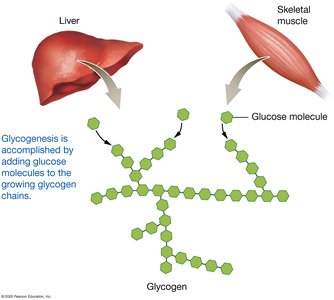
Glycogenesis is the process of storing excess glucose as glycogen, a large branched polysaccharide. This process primarily occurs in the liver and skeletal muscle cells, but most cells are capable of some glycogen storage.
Enzyme: Glycogen synthase catalyzes the addition of glucose units to growing glycogen chains.
Hormonal Regulation: Insulin stimulates glycogenesis after carbohydrate-rich meals.
Glycogenolysis
When blood glucose levels drop, glycogenolysis is triggered by hormones such as glucagon and epinephrine. This process breaks down glycogen into glucose, which is released into the bloodstream to maintain energy supply.
Gluconeogenesis
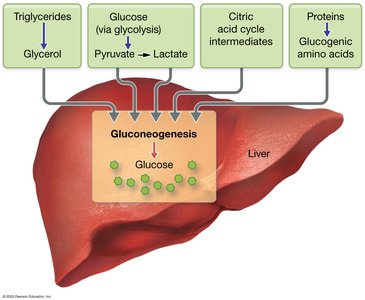
Gluconeogenesis is the synthesis of glucose from non-carbohydrate precursors, primarily in the liver and, to a lesser extent, in the kidneys. This process is essential during fasting or intense exercise when glucose reserves are depleted.
Substrates: Glycerol (from triglyceride breakdown), pyruvate and lactate (from glycolysis), citric acid cycle intermediates, and specific glucogenic amino acids.
Note: Fatty acids cannot be converted into glucose.
Lipogenesis
Lipogenesis is the process of synthesizing fatty acids from acetyl-CoA, primarily in the cytosol of liver and adipose cells. Fatty acid synthase catalyzes the elongation of fatty acid chains two carbons at a time. Glycerol and fatty acids can be derived from excess glucose and amino acids, not just dietary sources.
Excess glucose is converted to acetyl-CoA, then to fatty acids.
Excess amino acids can also be converted into triglycerides for storage.
Amino Acid Metabolism
The body can synthesize 11 of the 20 amino acids; the remaining 9 are essential and must be obtained from the diet. Amino acid synthesis involves adding amino groups to intermediates such as α-ketoglutarate, pyruvate, or oxaloacetate.
Excess amino acids can be converted to glucose (stored as glycogen) or fatty acids (stored as triglycerides).
Unused dietary amino acids are eliminated in fecal matter.
Metabolic States and Regulation
Absorptive State
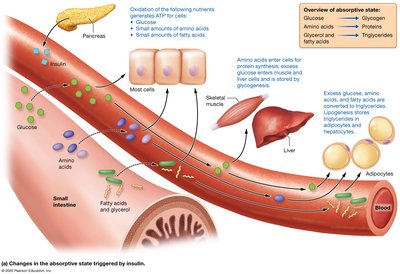
The absorptive state occurs during and shortly after eating, when nutrients are being absorbed into the bloodstream. Insulin is the primary hormone regulating this state, promoting the uptake and storage of glucose, fatty acids, and amino acids.
Glucose is used for ATP production or stored as glycogen in liver and muscle.
Excess nutrients are converted to triglycerides and stored in adipose tissue.
Post-Absorptive State
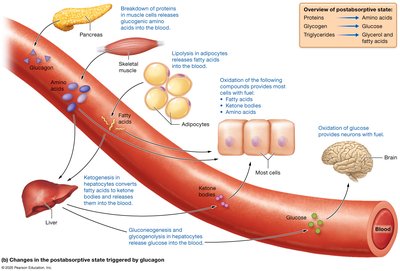
The post-absorptive state begins about four hours after a meal, when nutrient absorption from the digestive tract is complete. The body relies on stored fuels, and blood glucose is maintained by glucagon, epinephrine, norepinephrine, and cortisol.
Glycogenolysis and gluconeogenesis in the liver release glucose.
Lipolysis in adipose tissue releases fatty acids.
Ketogenesis in the liver produces ketone bodies for use by the brain, heart, and muscles.
Muscle proteins are broken down to release glucogenic amino acids.
Regulation of Feeding Behavior
Short-Term Regulation
Short-term regulation of feeding involves signals from the hypothalamus, blood glucose levels, hormones, and neural input from the digestive tract.
Satiety center and hunger center in the hypothalamus integrate signals.
Low blood glucose stimulates hunger (orexins release).
Insulin and stretch receptors in the stomach promote satiety (cholecystokinin release).
The vagus nerve suppresses hunger signals.
Long-Term Regulation
Leptin (from adipocytes) inhibits hunger and stimulates satiety, promoting the release of anorexigenic neurotransmitters.
Ghrelin (from stomach mucosa) stimulates hunger by promoting orexigenic neurotransmitters.
Metabolic Rate and Energy Balance
Metabolic Rate
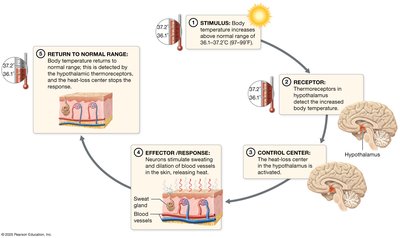
Metabolic rate is the total amount of energy expended by the body to power all physiological processes. It is measured in Calories (kilocalories). Metabolic processes release heat, which is crucial for thermoregulation.
Direct calorimetry measures heat production.
Indirect calorimetry measures oxygen consumption and carbon dioxide production.
BMR (Basal Metabolic Rate): The minimal rate of metabolism for an awake individual.
Energy Balance and Body Mass Index (BMI)
Energy balance is the relationship between energy intake (food) and energy expenditure (metabolic processes and physical activity). Body mass is regulated by maintaining energy balance.
Positive energy balance: Caloric intake exceeds expenditure, leading to weight gain.
Negative energy balance: Caloric intake is less than expenditure, leading to weight loss.
BMI (Body Mass Index): A measure of body mass relative to height.
Formula for BMI:
Macronutrients and Caloric Values
Calories for energy intake come from macronutrients:
Macronutrient | Energy Provided (kcal/gram) |
|---|---|
Carbohydrates | 4 |
Protein | 4 |
Lipids | 9 |
Alcohol | 7 |
Carbohydrates: Simple sugars and complex polysaccharides, mainly from plants. Lipids: Oils (plants) and solid fats (animals). Proteins: Supply essential and nonessential amino acids. Complete proteins are found in animal sources and some plants (e.g., soybeans, quinoa); incomplete proteins are found in other plant sources.
Additional info: Understanding the integration of these metabolic pathways is essential for comprehending how the body maintains energy homeostasis and adapts to varying nutritional states.
