 Back
BackThe Chemistry of Life: Foundations for Anatomy & Physiology
Study Guide - Smart Notes
 Tailored notes based on your materials, expanded with key definitions, examples, and context.
The Chemical Elements
Major and Trace Elements in the Human Body
The human body is composed of a variety of chemical elements, each with unique properties and biological roles. Understanding these elements is fundamental to the study of anatomy and physiology.
Element: The simplest form of matter with unique chemical properties.
Atomic Number: The number of protons in an element's nucleus, which identifies the element.
Major Elements: Oxygen, carbon, hydrogen, nitrogen, calcium, and phosphorus make up 98.5% of body weight.
Lesser Elements: Sulfur, potassium, sodium, chlorine, magnesium, and iron contribute to another 0.8%.
Trace Elements: The remaining 0.7% consists of elements required in minute amounts for physiological functions.
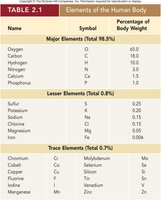
Minerals are inorganic elements extracted from soil by plants and passed up the food chain. They are essential for structure (e.g., bones, teeth), enzyme function, and as electrolytes for nerve and muscle activity.
The Periodic Table and Element Symbols
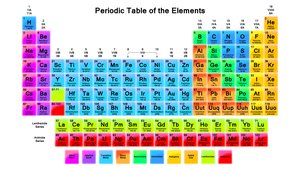
The periodic table organizes elements by atomic number and symbol. Each element is represented by a one- or two-letter symbol, often derived from its English or Latin name (e.g., Na for sodium from natrium).
The Structure of Atoms
Atomic Structure
Atoms are the smallest units of matter that retain the properties of an element. They consist of a central nucleus (containing protons and neutrons) and electrons that orbit the nucleus in shells.
Protons: Positively charged particles in the nucleus.
Neutrons: Uncharged particles in the nucleus.
Electrons: Negatively charged particles orbiting the nucleus.
In a neutral atom, the number of protons equals the number of electrons.
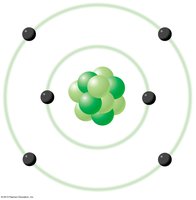
The atomic weight is approximately the sum of protons and neutrons in the nucleus.
Chemical Bonds and Molecules
How Atoms Form Molecules
Atoms combine to complete their outermost electron shells, forming molecules through chemical bonds. The number of electrons needed to fill the outer shell is called the valence of the atom.
Molecule: Two or more atoms held together by chemical bonds.
Compound: A molecule containing at least two different elements (e.g., H2O).
Ionic Bonds
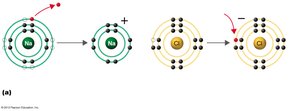
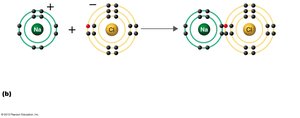
Ionic bonds form when one atom donates electrons to another, resulting in oppositely charged ions that attract each other. For example, sodium (Na) loses an electron to become Na+, and chlorine (Cl) gains an electron to become Cl−. The resulting NaCl is held together by ionic bonds.
Covalent Bonds
Covalent bonds occur when two atoms share one or more pairs of electrons. These bonds are strong and common in biological molecules. For example, two hydrogen atoms share electrons to form H2, and carbon forms four covalent bonds in methane (CH4).
Hydrogen Bonds
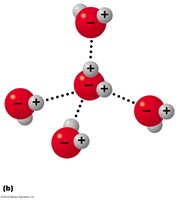
Hydrogen bonds are weak attractions between a hydrogen atom covalently bonded to an electronegative atom (like O or N) and another electronegative atom. They are crucial for the structure of water and biological macromolecules.
Ions, Electrolytes, and Free Radicals
Electrolytes
Electrolytes are salts that ionize in water, forming solutions that conduct electricity. They are vital for chemical reactivity, osmotic balance, and electrical activity in nerves and muscles.
Imbalances can cause muscle cramps, brittle bones, coma, or cardiac arrest.
Free Radicals and Antioxidants
Free radicals are chemical particles with an odd number of electrons, produced by metabolism, radiation, or chemicals. They can damage tissues, contribute to aging, and cause diseases like cancer. Antioxidants neutralize free radicals, protecting the body.
Examples: Superoxide dismutase (SOD) in the body; selenium, vitamin E, vitamin C, and carotenoids in the diet.
Water and Mixtures
Properties of Water
Water is the universal solvent, making up 50–75% of body weight. Its ability to dissolve substances is essential for metabolic reactions. Substances that dissolve in water are hydrophilic (polar or charged), while those that do not are hydrophobic (nonpolar or neutral).
Types of Mixtures
Solution: Solute particles under 1 nm, do not scatter light, pass through membranes, do not separate on standing.
Colloid: Particles 1–100 nm, scatter light, do not pass through membranes, remain mixed.
Suspension: Particles over 100 nm, cloudy/opaque, separate on standing (e.g., blood).
Emulsion: Suspension of one liquid in another (e.g., fat in breast milk).




Acids, Bases, and pH
Definitions and pH Scale
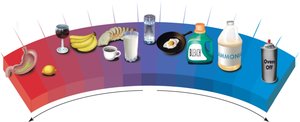
Acids are proton donors (release H+ in water), while bases are proton acceptors (accept H+ or release OH−). The pH scale measures the concentration of H+ ions:
pH 7.0: Neutral (H+ = OH−)
pH < 7.0: Acidic (H+ > OH−)
pH > 7.0: Basic (OH− > H+)
Equation for pH:
Energy and Chemical Reactions
Types of Energy
Potential Energy: Stored energy due to position or structure (e.g., chemical bonds).
Kinetic Energy: Energy of motion (e.g., heat, movement of molecules).
Free Energy: Energy available to do work in a system.
Classes of Chemical Reactions
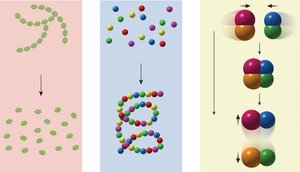
Decomposition Reaction: Large molecule breaks down into smaller ones.
Synthesis Reaction: Two or more small molecules combine to form a larger one.
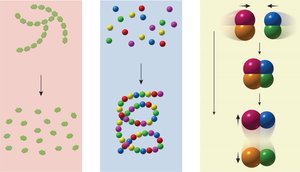
Metabolism: Catabolism and Anabolism
Catabolism: Energy-releasing (exergonic) decomposition reactions that break covalent bonds, producing smaller molecules and releasing energy.
Anabolism: Energy-storing (endergonic) synthesis reactions that require energy input to build larger molecules (e.g., proteins, fats).
Catabolism and anabolism are linked; energy released by catabolism drives anabolism.
Organic Compounds and Functional Groups
Categories of Organic Compounds
Organic chemistry is the study of carbon-containing compounds. The four main categories in the body are:
Carbohydrates
Lipids
Proteins
Nucleotides and nucleic acids
