Predict which would be more damaging to long-term survival: a blood clot lodged in the right coronary artery or one in the left coronary artery. Explain.
Ch. 18 The Cardiovascular System II: The Blood Vessels
Chapter 18, Problem L2.3
Collagen vascular diseases weaken the collagen in the tunica externa of blood vessels. Predict the effects of such a disease.
Verified step by step guidance1
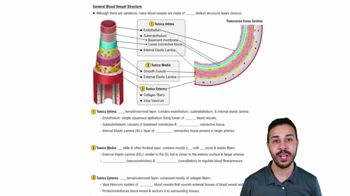
Understand the structure of blood vessels: Blood vessels have three layers—tunica intima (innermost), tunica media (middle), and tunica externa (outermost). The tunica externa is primarily composed of collagen fibers, which provide structural support and prevent overexpansion of the vessel walls.
Recognize the role of collagen in the tunica externa: Collagen fibers in the tunica externa are essential for maintaining the integrity and strength of blood vessels. They help resist mechanical stress and prevent rupture under high pressure.
Predict the effects of weakened collagen: If collagen in the tunica externa is weakened due to a collagen vascular disease, the structural support of the blood vessels will be compromised. This can lead to increased susceptibility to aneurysms (localized dilation of the vessel wall) or rupture, especially in high-pressure arteries.
Consider the impact on blood flow and circulation: Weakening of the tunica externa may result in irregular blood flow due to vessel deformation or rupture. This can impair oxygen and nutrient delivery to tissues and organs, potentially leading to ischemia or other complications.
Evaluate systemic consequences: Collagen vascular diseases affecting multiple blood vessels can lead to widespread circulatory issues, including organ damage, hemorrhage, or increased risk of cardiovascular events such as stroke or heart attack.

Verified video answer for a similar problem:
This video solution was recommended by our tutors as helpful for the problem above.
Was this helpful?
Key Concepts
Here are the essential concepts you must grasp in order to answer the question correctly.
Collagen Structure and Function
Collagen is a primary structural protein in the body, providing strength and support to various tissues, including blood vessels. It forms a fibrous network that helps maintain the integrity and elasticity of the tunica externa, the outer layer of blood vessels. Weakening of collagen due to diseases can lead to compromised vessel structure and function.
Recommended video:
Functional Groups
Tunica Externa
The tunica externa, or adventitia, is the outermost layer of blood vessels, composed mainly of connective tissue that includes collagen fibers. This layer provides structural support and protection to the vessel, anchoring it to surrounding tissues. Damage or weakening of this layer can result in increased susceptibility to injury and vascular instability.
Recommended video:
General Blood Vessel Structure
Effects of Collagen Vascular Diseases
Collagen vascular diseases, such as Ehlers-Danlos syndrome or systemic lupus erythematosus, can lead to a range of vascular complications. These may include increased fragility of blood vessels, higher risk of aneurysms, and impaired blood flow. Such conditions can ultimately result in serious health issues, including hemorrhage or organ damage due to inadequate blood supply.
Recommended video:
Guided course
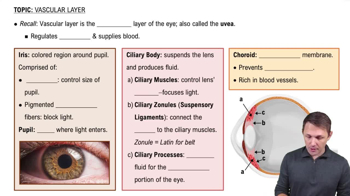
Vascular Layer
Related Practice
Textbook Question
886
views
1
rank
Textbook Question
A birth defect called transposition of great vessels results in the pulmonary trunk emanating from the left ventricle and the aorta stemming from the right ventricle.
Predict the potential effects of this birth defect.
748
views
Textbook Question
Explain why a severed artery spurts blood, whereas a severed vein merely leaks blood.
929
views
Textbook Question
Explain why a person who is 7 feet tall is likely to have higher blood pressure than a person whose height is 4 feet.
969
views
Textbook Question
The carotid sinus contains:
a. Baroreceptors
b. Chemoreceptors
c. Metabolic controls
d. Smooth muscle cells
1054
views
Textbook Question
Locations where vessels connect via collateral vessels are known as:
a. Thoroughfare channels
b. Metarterioles
c. Anastomoses
d. Venules
739
views
1
rank