Ch. 18 The Cardiovascular System II: The Blood Vessels
Amerman - Human Anatomy & Physiology 2nd Edition
Amerman2nd EditionHuman Anatomy & PhysiologyISBN: 9780136873822Not the one you use?Change textbook
Chapter 18, Problem L2.2

Explain why a person who is 7 feet tall is likely to have higher blood pressure than a person whose height is 4 feet.

Verified step by step guidance
1
Understand the relationship between height and blood pressure: Blood pressure is influenced by the distance blood must travel from the heart to the extremities. Taller individuals have longer blood vessels, which can increase resistance to blood flow.
Consider the role of gravity: In taller individuals, the heart must work harder to pump blood against gravity to reach the upper extremities (e.g., the brain) and to return blood from the lower extremities (e.g., the legs). This increased workload can contribute to higher blood pressure.
Analyze the concept of vascular resistance: Longer blood vessels in taller individuals result in greater total peripheral resistance. According to the formula for blood flow, \( Q = \frac{\Delta P}{R} \), where \( Q \) is blood flow, \( \Delta P \) is the pressure difference, and \( R \) is resistance, higher resistance requires higher pressure to maintain adequate blood flow.
Examine the role of hydrostatic pressure: Hydrostatic pressure increases with height due to the column of blood in the vessels. Taller individuals experience greater hydrostatic pressure in their lower extremities, which can contribute to overall higher blood pressure.
Consider the physiological adaptations: While taller individuals may have higher blood pressure due to these factors, their cardiovascular system may adapt over time to compensate for the increased demands, such as stronger heart muscles or more efficient blood vessel regulation.

Verified video answer for a similar problem:

This video solution was recommended by our tutors as helpful for the problem above.
Was this helpful?

Key Concepts

Here are the essential concepts you must grasp in order to answer the question correctly.

Height and Blood Pressure Relationship

Research indicates that taller individuals often experience higher blood pressure due to the increased volume of blood required to supply their larger body mass. This relationship is influenced by the need for the heart to exert more force to circulate blood throughout a greater distance, leading to elevated pressure levels.
Recommended video:
Guided course
5:46
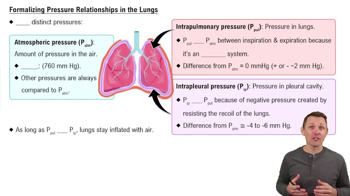
Formalizing Pressure Relationships in the Lungs

Body Mass Index (BMI)

BMI is a measure that relates body weight to height, providing insight into body composition. A higher BMI, often associated with taller individuals, can contribute to increased blood pressure as excess weight can strain the cardiovascular system, leading to hypertension over time.
Recommended video:
Guided course
1:21
Organization of the Body: Body Cavities Example 1

Cardiovascular System Dynamics

The cardiovascular system's dynamics involve the heart's ability to pump blood and the resistance encountered in blood vessels. Taller individuals may have larger blood vessels and increased vascular resistance, which can elevate blood pressure as the heart works harder to maintain adequate blood flow throughout the body.
Recommended video:
6:06
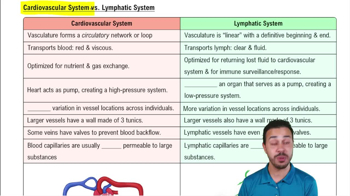
Cardiovascular System vs. Lymphatic System