Ch. 18 The Cardiovascular System II: The Blood Vessels
Amerman - Human Anatomy & Physiology 2nd Edition
Amerman2nd EditionHuman Anatomy & PhysiologyISBN: 9780136873822Not the one you use?Change textbook
Chapter 18, Problem L3.1

You are babysitting two children who are having a contest to see who can hang upside-down for the longest time. At the end of the contest, both children feel dizzy and are worried they are sick. Explain to them why they feel this way and why the effect is only temporary. (Hint: Consider how the baroreceptor reflex responds when a person hangs upside-down.)

Verified step by step guidance
1
Explain to the children that when they hang upside-down, gravity causes blood to pool in the upper part of their body, particularly in the head. This increases the pressure in the blood vessels of the brain and face.
Introduce the concept of baroreceptors, which are specialized sensors located in the walls of certain blood vessels, such as the carotid arteries and aortic arch. These sensors detect changes in blood pressure and send signals to the brain to regulate it.
Describe how the baroreceptor reflex works: When the blood pressure in the head increases due to being upside-down, the baroreceptors signal the brain to lower the heart rate and dilate blood vessels to reduce the pressure. This is the body's attempt to maintain homeostasis.
Explain that the dizziness they feel is a temporary effect caused by the sudden changes in blood pressure and the body's adjustment process. Once they return to an upright position, the baroreceptor reflex helps normalize blood pressure, and the dizziness subsides.
Reassure them that this is a normal physiological response and not a sign of illness. Their bodies are simply adapting to the unusual position, and the effect will pass as their blood pressure stabilizes.

Verified video answer for a similar problem:

This video solution was recommended by our tutors as helpful for the problem above.
Was this helpful?

Key Concepts

Here are the essential concepts you must grasp in order to answer the question correctly.

Baroreceptor Reflex

The baroreceptor reflex is a physiological mechanism that helps regulate blood pressure. Baroreceptors, located in the carotid arteries and aorta, detect changes in blood pressure and send signals to the brain to adjust heart rate and blood vessel diameter. When hanging upside-down, blood pools in the head, causing increased pressure, which the body must quickly adapt to in order to maintain stable blood flow and pressure.
Recommended video:
3:37
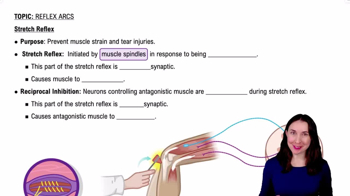
Stretch Reflex

Vestibular System

The vestibular system is responsible for maintaining balance and spatial orientation. It consists of structures in the inner ear that detect changes in head position and motion. When the children hang upside-down, the fluid in the inner ear shifts, leading to confusion in the brain about their orientation, which can cause dizziness and a sensation of imbalance.
Recommended video:
4:25
Complement System

Temporary Effects of Dizziness

The dizziness experienced by the children is temporary because the body has mechanisms to quickly adapt to changes in position. Once they return to an upright position, the baroreceptor reflex and vestibular system recalibrate, restoring normal blood flow and balance. This adaptation process helps prevent prolonged dizziness and allows the body to recover from the effects of hanging upside-down.
Recommended video:
1:32
Effects of the Complement System
Related Practice
Textbook Question

Explain why the skin and lips of fair-skinned individuals may 'turn blue' in very cold weather.

800
views
Textbook Question

Which of the following factors would increase peripheral resistance?

a. Increased blood viscosity

b. Shorter vessel

c. Vasodilation

d. An increase in vessel radius

1097
views
Textbook Question

The carotid sinus contains:

a. Baroreceptors

b. Chemoreceptors

c. Metabolic controls

d. Smooth muscle cells

1054
views
Textbook Question

Predict the effects of each of the following on systemic arterial blood pressure:

Caffeine consumption, which increases heart rate and causes vasoconstriction

667
views
Textbook Question

Match the following terms with the correct definition.

____ Auricle      

____ Aorta      

____ Coronary sinus       

____ Papillary muscle      

____ Fossa ovalis     

____ Pectinate muscle      

____ Venae cavae      

____ Pulmonary trunk      

____ Chordae tendineae      

____ Pulmonary veins 

a. Drainage point for the coronary veins

b. Extensions that attach papillary muscles to valves

c. Remnant of a hole present in the fetal interatrial septum

d. Two largest veins of the systemic circuit

e. Flaplike extension from the right or left atrium

f. Finger-like projections of ventricular muscle

g. Main artery of the pulmonary circuit

h. Veins that drain the pulmonary circuit

i. Largest artery of the systemic circuit

j. Ridges of muscle in the atria

677
views
Textbook Question

Ms. Rodgers has been diagnosed with secretion of inappropriate ADH syndrome (SIADH). What effect will SIADH have on the amount of water in her body? What symptoms would you expect from this condition? How would it affect her blood pressure and net filtration pressure?

835
views