Ch. 22 The Digestive System
Amerman - Human Anatomy & Physiology 2nd Edition
Amerman2nd EditionHuman Anatomy & PhysiologyISBN: 9780136873822Not the one you use?Change textbook
Chapter 22, Problem L3.1b

Mr. Williams presents to your clinic with a complaint of abdominal pain in the right upper quadrant. He says that the pain worsens when he eats, particularly when he eats fatty meals. He has noticed that his stool has been an unusual clay color recently. You perform an ultrasound of his abdomen and find that gallstones are blocking his common bile duct, preventing bile from entering the duodenum.
You test Mr. Williams's stool and find high amounts of undigested fats. Explain this finding.

Verified step by step guidance
1
Understand the role of bile in digestion: Bile is produced by the liver and stored in the gallbladder. It contains bile salts, which are essential for emulsifying fats in the small intestine. Emulsification breaks large fat globules into smaller droplets, increasing the surface area for lipase enzymes to act on and digest fats.
Identify the consequence of a blocked common bile duct: When gallstones block the common bile duct, bile cannot flow into the duodenum. This prevents bile salts from reaching the small intestine, which disrupts the emulsification of fats.
Connect the lack of bile to fat digestion: Without bile salts, fats remain in large globules, making it difficult for pancreatic lipase to effectively break them down into fatty acids and monoglycerides. This leads to undigested fats passing through the digestive system.
Explain the presence of undigested fats in the stool: The undigested fats are excreted in the stool, a condition known as steatorrhea. This explains the high amounts of undigested fats found in Mr. Williams's stool sample.
Relate the clay-colored stool to bile absence: Bile also contains pigments, such as bilirubin, which give stool its characteristic brown color. When bile flow is obstructed, these pigments do not reach the intestine, resulting in pale or clay-colored stool.

Key Concepts

Here are the essential concepts you must grasp in order to answer the question correctly.

Bile Function

Bile is a digestive fluid produced by the liver and stored in the gallbladder, essential for the emulsification and digestion of fats. It contains bile salts that help break down fats into smaller droplets, making them easier for digestive enzymes to act upon. When bile flow is obstructed, as in Mr. Williams's case with gallstones blocking the common bile duct, fat digestion is impaired, leading to the presence of undigested fats in the stool.
Recommended video:
Guided course
6:54
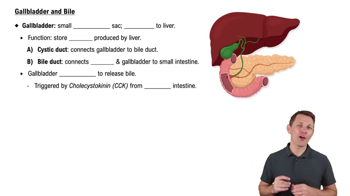
Gallbladder and Bile

Gallstones and Biliary Obstruction

Gallstones are solid particles that form in the gallbladder and can obstruct the bile ducts, preventing bile from reaching the intestines. This obstruction can lead to symptoms such as abdominal pain, especially after fatty meals, and can cause changes in stool color and consistency. In Mr. Williams's case, the blockage of the common bile duct results in a lack of bile entering the duodenum, which is crucial for fat digestion.
Recommended video:
7:24
Anastomoses Form Collateral Channels

Steatorrhea

Steatorrhea refers to the presence of excess fat in the stool, often resulting from malabsorption of fats due to insufficient bile or pancreatic enzymes. In Mr. Williams's situation, the high amounts of undigested fats in his stool indicate that the obstruction of bile flow has led to inadequate fat digestion, causing the stool to appear clay-colored and greasy, a hallmark of steatorrhea.
Related Practice
Textbook Question

A surgical procedure known as gastric bypass involves removing all or part of the stomach.

How would stomach removal affect absorption of vitamin B12? Explain.

711
views
Textbook Question

Individuals experiencing prolonged vomiting lose a great deal of hydrochloric acid with the vomitus. Predict the effect this loss of acid will have on the pH of the blood. How will the respiratory system respond to the change in pH?

876
views
Textbook Question

Mr. Williams presents to your clinic with a complaint of abdominal pain in the right upper quadrant. He says that the pain worsens when he eats, particularly when he eats fatty meals. He has noticed that his stool has been an unusual clay color recently. You perform an ultrasound of his abdomen and find that gallstones are blocking his common bile duct, preventing bile from entering the duodenum.

Explain why his feces have become a clay color instead of a normal brown color.

639
views
Textbook Question

A surgical procedure known as gastric bypass involves removing all or part of the stomach.

Ms. Anthony has undergone gastric bypass, and her stomach has been removed entirely. She goes out to dinner and eats an extremely large meal. Explain what will happen in her small and large intestine following this meal.

701
views
Textbook Question

Mr. Williams presents to your clinic with a complaint of abdominal pain in the right upper quadrant. He says that the pain worsens when he eats, particularly when he eats fatty meals. He has noticed that his stool has been an unusual clay color recently. You perform an ultrasound of his abdomen and find that gallstones are blocking his common bile duct, preventing bile from entering the duodenum.

Why are his symptoms worse when he consumes a high-fat meal? Would you expect his symptoms to worsen or lessen when he consumes a meal consisting only of carbohydrates? Explain.

727
views
Textbook Question

Mark the following statements as true or false. If a statement is false, correct it to make a true statement.

The mucosa from the stomach to the anus consists of an inner layer of stratified columnar epithelium.

1011
views