
Ch. 1 The Human Body: An Orientation
Hoehn - Marieb Human Anatomy & Physiology, 12th edition
Hoehn, Haynes, Abbott12th EditionMarieb Human Anatomy & PhysiologyISBN: 9780138242732Not the one you use?Change textbook
Chapter 1, Problem 18

Compare and contrast the operation of negative and positive feedback mechanisms in maintaining homeostasis. Provide two examples of variables controlled by negative feedback mechanisms and one example of a process regulated by a positive feedback mechanism.

Verified step by step guidance
1
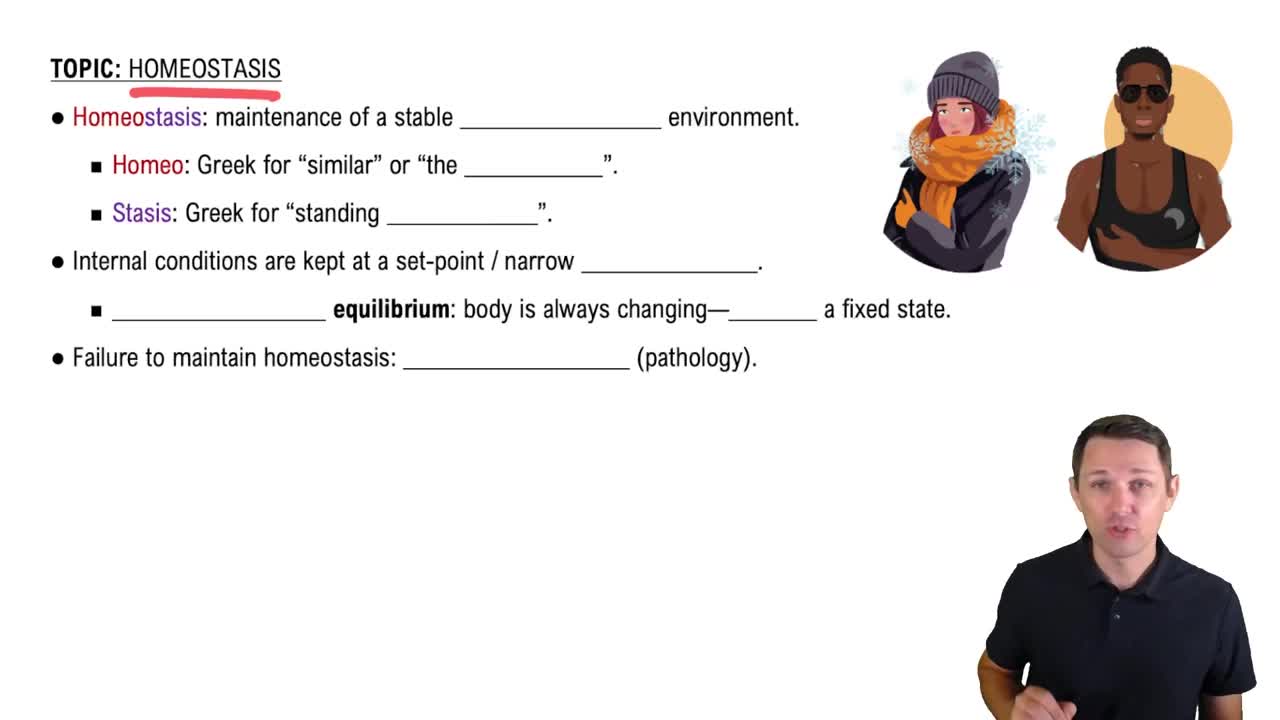
Begin by defining homeostasis as the body's ability to maintain a stable internal environment despite external changes, which is crucial for proper physiological function.
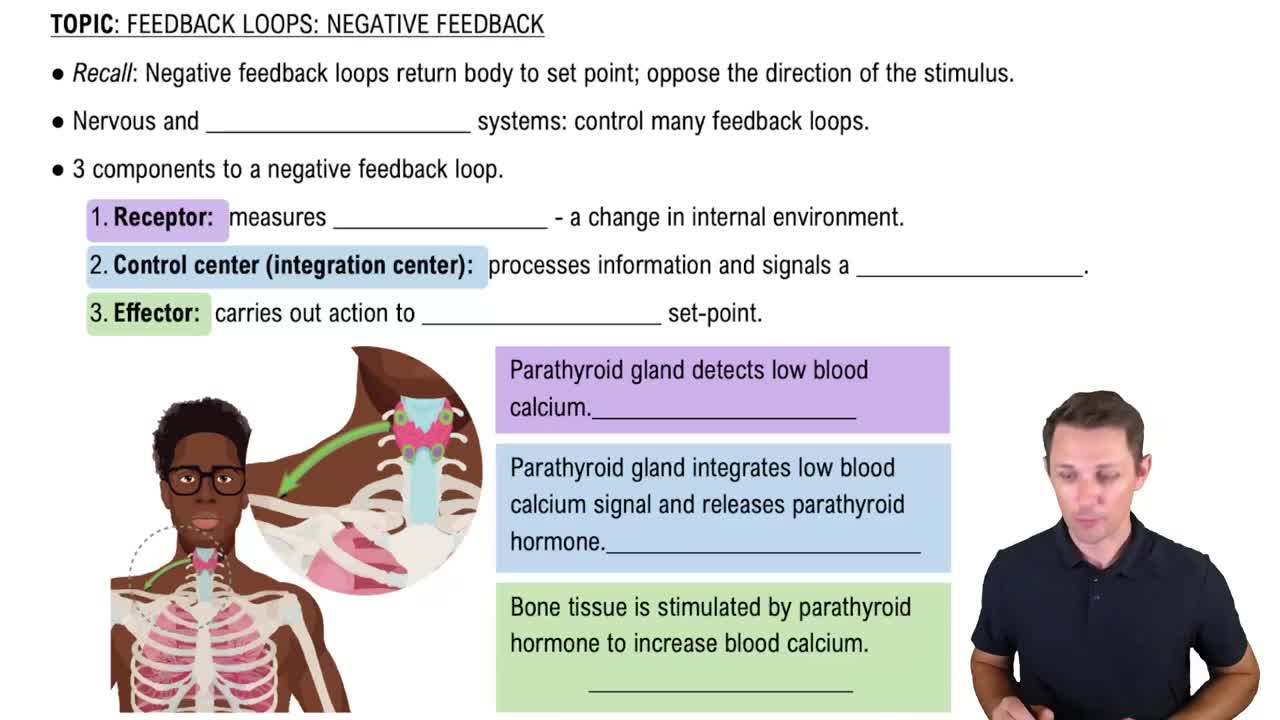
Explain negative feedback mechanisms: these work by detecting a deviation from a set point and initiating responses that reverse the change, bringing the variable back to normal. This is a self-correcting process that maintains balance.
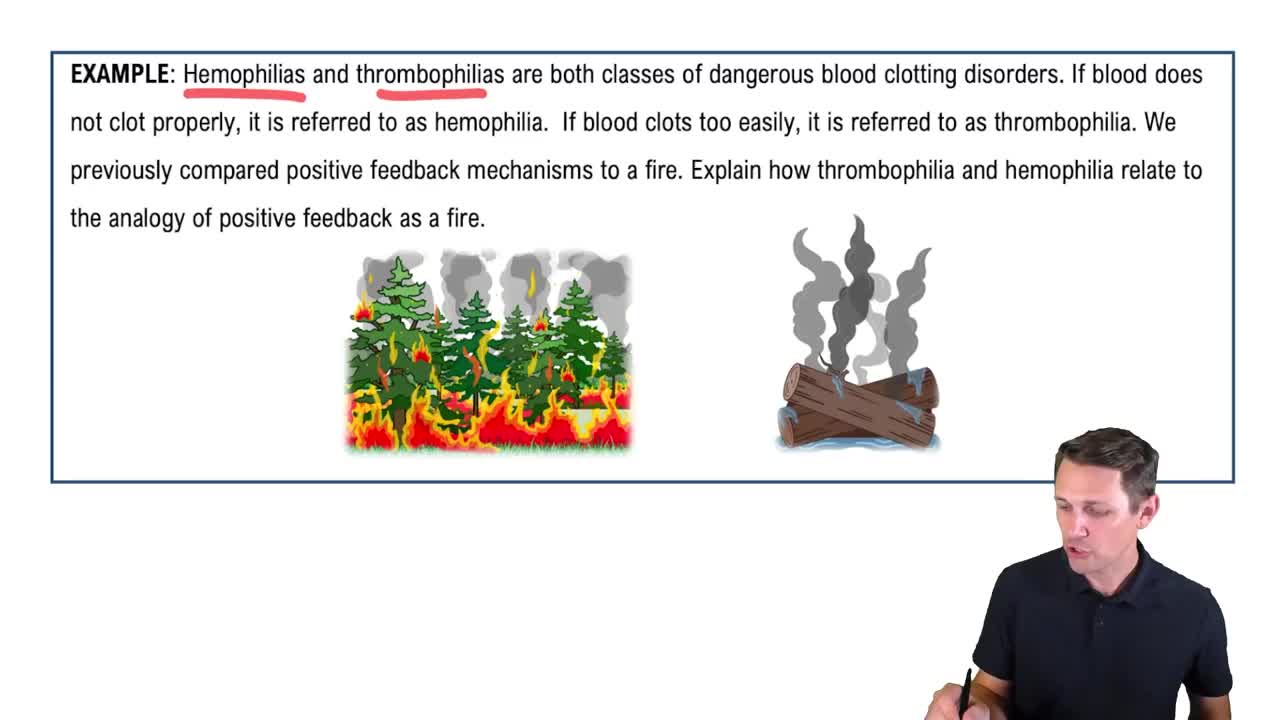
Explain positive feedback mechanisms: these amplify or reinforce a change in a variable, pushing it further away from the set point. This process is less common and usually controls events that need a definitive outcome, not continuous regulation.
Provide two examples of variables controlled by negative feedback, such as body temperature regulation (thermoregulation) and blood glucose levels. Describe briefly how each uses negative feedback to maintain homeostasis.
Provide one example of a process regulated by positive feedback, such as the release of oxytocin during childbirth, where the feedback loop intensifies contractions until delivery occurs.

Verified video answer for a similar problem:

This video solution was recommended by our tutors as helpful for the problem above.
Video duration:
2m
Was this helpful?

Key Concepts

Here are the essential concepts you must grasp in order to answer the question correctly.

Negative Feedback Mechanisms

Negative feedback mechanisms maintain homeostasis by reversing a change in a controlled variable, bringing it back to its set point. When a deviation occurs, sensors detect it and trigger responses that counteract the change, stabilizing the system. For example, body temperature regulation and blood glucose control operate via negative feedback.
Recommended video:
Guided course
03:26
Negative Feedback Loops

Positive Feedback Mechanisms

Positive feedback mechanisms amplify a change rather than reversing it, pushing the system further from its original state. This process is less common and usually occurs in situations requiring a definitive outcome, such as childbirth, where contractions intensify until delivery is complete.
Recommended video:
Guided course
02:43
Feedback Loops: Positive Feedback Example 1

Homeostasis and Its Importance

Homeostasis refers to the body's ability to maintain a stable internal environment despite external changes. It involves multiple feedback systems that regulate variables like temperature, pH, and glucose levels, ensuring optimal conditions for cellular function and overall health.
Recommended video:
Guided course
01:59
Introduction to Homeostasis
Related Practice
Textbook Question

At the clinic, Harry was told that blood would be drawn from his antecubital region. What body part was Harry asked to hold out? Later, the nurse came in and gave Harry a shot of penicillin in the area just distal to his acromial region. Did Harry take off his shirt or drop his pants to receive the injection? Before Harry left, the nurse noticed that Harry had a nasty bruise on his gluteal region. What part of his body was black and blue?

1072
views
Textbook Question

Relate each of the following conditions or statements to either the dorsal body cavity or the ventral body cavity.

a. Surrounded by the bony skull and the vertebral column

b. Includes the thoracic and abdominopelvic cavities

c. Contains the brain and spinal cord

d. Contains the heart, lungs, and digestive organs

923
views
Textbook Question

Assume that the body has been sectioned along three planes: (1) a median plane, (2) a frontal plane, and (3) a transverse plane made at the level of each of the organs listed below. Which organs would be visible in only one or two of these three cases?

a. Urinary bladder

b. Brain

c. Lungs

d. Kidneys

e. Small intestine

f. Heart

1576
views
Textbook Question

Use as many directional terms as you can to describe the relationship between the elbow's olecranal region and your palm.

1641
views
Textbook Question

Which of the following relationships is incorrect?

a. Visceral peritoneum/outer surface of small intestine

b. Parietal pericardium/outer surface of heart

c. Parietal pleura/wall of thoracic cavity

1175
views
1
rank
Textbook Question

Why is an understanding of the anatomical position important?

1651
views